As a break from everything else that's been going on lately, I've been reading/watching a variety of what could be largely lumped as "science communication" blogs/videos. While I've been doing so, I of course have run across the odd "why do science communication?" post. The answers usually boil down to geekery ("because science is so cool and people should know it"), political ("If everyone were more science literate, they would vote X"), or humanitarian ("if people understood [this], they wouldn't be hurt by [that] or taken in by charlatans"). These are by no means bad motives for doing these things. And I utterly agree that science communication is a critical activity in our day and age.
But, why? Why is science so hard to communicate that we need not only institutionalized communication (e.g. science class), but grassroots efforts, from blogs to podcasts to videos to local science festivals? Humans have been communicating stuff to each other for centuries. We have developed a wide variety of methods and tools for convincing people of things. Heck, we have a whole industry dedicated to it (advertising). Why does science communication seem so hard to do sometimes?
First, there is the sheer logistical reality of it. The better you understand a topic, let's say optics since I know that one, the deeper you've gone into it and the more that subject and it's prerequisites have become second nature to you. You now now Maxwell's equations almost instinctually. You have a gut reaction when you see velocities faster than \( 3*10^8 \ . You either stopped asking what was waving or have dug really deep into it, but either way you probably can't explain it in 100 words or less to the average person on the street. On the other hand, the less you know the topic, the easier it is to explain at your level of understanding to someone who doesn't know much or anything, because you remember being in that state.
I have slowly started to realize this as I've been teaching problem solving sessions for the past five semesters. When I started out, I was not remotely confident in the topic. I had taken a few courses beyond the level I was teaching, but I knew I didn't really *know*, in the sense of understanding and internalizing, even basic electromagnetism. My algebra/calculus was shaky because I didn't do it all day, everyday, and hadn't really touched it in 8 months (I took some time off between undergrad and grad school).
So everytime I taught, I had very very detailed notes explaining the calculation to myself, because I knew I couldn't do it unprepared. My students were able to follow my solutions (handwriting permitting) because I wrote everything out, every single step, no "and it can easily be shown that", no "clearly, this equals". It was there. But my analogies to explain the weirdness of electromagnetism were terrible. I mean, really really terrible. Confused, convoluted, mixed. And I didn't have a sense of the background of my students, what they would or would not be familiar with.
Now, I do algebra and calculus for my PhD research. My dining room table, my chalkboard, my whiteboard, my desk, random napkins are full of equations. I sit and do page after page (and redo page after page) of math. I've gotten better at recognizing common algebraic patterns. I no longer have to FOIL simpler multiplications. I do not question the utility of sines and cosines. It's obvious! So my worked out solutions in class have started to skips steps. Bit by bit, I assume a higher level of math literacy from my students. My analogies and metaphors have, generally, become better. I no longer mix metaphors, I stick with one main metaphor throughout a topic, and I don't use analogies to things that my students have no idea what that is. So while my students feel less baffled by my words, I get a dozen of them before and after class asking how we got from point A to point B in an equation.
And this is I think a hurdle science communicators have to face. The best ones are good in their field. They breathe physics, chemistry, biology, what have you. It's a core component of their being and they are excited to share it with you. But it also means that they are far away from the confusion and doubts of their audience. They need to practice that skill of empathy which, at least in pop culture, we famously lack. It's not an easy skill, to put yourself back at that point of confusion and try to talk to that person. It's like trying to teach a small child something that is to you so easy you don't think about it, like tying your shoes. The best thing is to have a non-STEM friend to test out your explanations on, but even they can be a biased sample depending on how frequently you try to explain your work to them.
The second problem, as the many youtube comment sections to these videos attest, is that science bumps up uncomfortably against areas of worldview and identity for people. The world is a big, nasty, confusing place and people build their worldviews and identities in a way that, fundamentally, tries to make them feel safe, even if it is a very weird and convoluted safety. For example, conspiracy theorists, whatever their theory of choice, want to believe that someone is in control. The idea that violence or disease or natural disaster just happen, is intolerable. Far preferable that a malevolent and powerful group somewhere is in charge than we being hostages to fortune.
And this is even harder than empathy for confusion, because it does not require a shoveling on of better explained facts, or more facts. It requires the mindset of a missionary instead of a teacher and it is a very different mindset. Its also a mindset that makes many scientists uncomfortable. Science isn't a religion, it isn't faith, it's fact. Facts exist whether you want them to exist or not. But science is increasingly touching areas of our lives that are not experienced as fully rational, where strong beliefs are preexistent and the science communicators job is no longer to make clear something that was not thought of or not understood, but to modify or replace beliefs. And it is a much longer process.
I feel it is important to note here that science communicators should also be aware of where to stop. There is a fine line between teaching scientific truth and teaching your world view. Most of the time I have seen science communication blow up is where that line is crossed. For example, please, by all means explain the correct mechanisms for evolution and the strength of evidence we have for it. The minute you say "See? You don't need a god to make this work after all" you have lost any ground or good will you may have gained.
I think we could borrow a bit from missionaries, modified to our needs. One of the classic techniques for missionaries is to talk to people, and begin from their starting point. The missionary can then more easily lead in small steps to the point where the next step is faith or not faith. I don't see why would couldn't develop a similar method for science communication where the problem is not information but belief. Again, using evolution as an example. Starting with something close to home (antibiotic resistant infections), moving further afield to elephants losing their tusks as a defense against ivory poaching, to dogs from wolves, making the gradual transition from 'microevolution' to 'macroevolution' to a final understanding that it is all just 'evolution'. But again, changing beliefs is not fast. It requires investment.
So, what is it that I am trying to say? Are we doing science communication badly? Should we stop doing it unless we can be just great? NO. By no means. What I am saying is that we already have a community of science communicators who are really good at what they do. Dr Skyskull has a great blog for weird physics, occasionally cats and horror. Myles Power has a bunch of great videos largely debunking bad science/logic in a fairly respectful manner even if his language is a little coarse to american ears. JimTheEvo has a really cool series on infection, evolution and human history*. My point is that we can be even better. Maybe by focusing our audience, maybe just by being more thoughtful. I think it might be time to move to the next level.
*I know they are all males. The women scientist blogs I read are less explaining and more linking to it things people would know. Powered by Osteons does a great job pointing out where bioanthropology intersects popular culture, for example.

Showing posts with label optics. Show all posts
Showing posts with label optics. Show all posts
Monday, June 23, 2014


Friday, May 23, 2014
What makes a light source safe?
Working in a science comes with an occupational hazard of head-slapping. It doesn't matter how tolerant, how understanding you are of the fact that not everyone is a scientist and therefore lacks some of the insight that we take for granted. On a semi-regular basis, you find yourself face-palming, banging your head against a wall and generally weeping for the scientific literacy of humanity. Whether it's a friend from college who has gone all homeopathic, a movie with impossible physics or a local news item that gets you to scream at the television, it's part of the territory.
Which is why I couldn't be all that surprised when, upon complimenting a coworker's manicure, I learned that her mother had gotten a free UV nail lamp because the cosmetology board had decided to replace all their old bulb UV lamps with LED light sources because they were 'safer'. My coworker laughed as she told me this, because we both know that it doesn't matter if your UV light is naturally emitted from unicorn horns fed only the most organic of herbage, it's still UV light and it can still give you cancer.
So, what makes a light source 'safe'? It depends, in part, on what you are using the light source for.
For example, in your house, you want a light bulb that isn't going to set your house on fire, explode, or release toxic gases. You aren't really worried about whether they can give you cancer, because the light they output is in the visible range, and sometimes into the infrared, all of which is non-ionizing. There are three options widely available to average person these days. There is old school incandescent bulbs, halogen bulbs and LED bulbs.
Incandescent are familiar, and what most people alive today grew up with. They have a filament that glows white hot when you pass a current through them. They do not have any toxic gases and most people seem to think of them as the non-toxic bulb (though the tungsten in the filament is highly toxic, it's sitting there and who is going to lick it?) But it's incredibly energy inefficient. Most of the energy it uses goes to heat (infrared), not visible light. You can burn yourself by touching one that's been on a little while, and they can explode from thermal shock if you accidentally sneeze on one that has been on long enough to get hot (yes, I have done this).
Halogens are becoming more familiar. They work just like any good old fluorescent bulb, with less flickering, by exciting electrons in a diffuse gas until they give off light, which then excites a coating on the bulb into giving white light. They are more energy efficient since heat is a byproduct and not the means of producing light, but they aren't hugely more efficient and they contain small amounts of mercury. They have to be disposed of properly at hardware stores or recycling centers, and it's not clear what you should do if one breaks.
LEDs are the newest contenders. They use light emitting diodes to create light, which means they are semiconductor based. Semiconductors aren't the nicest things in the world to make, but they are not toxic if they break. They are very efficient (some of the better ones barely get warm) and very pricey. They have by far the longest lifespan, and are probably the nicest looking.
So for safety, in my house, I am switching over to LED bulbs as each of the other style bulbs give up the ghost. Lower fire risk and no risk of mercury poisoning. This is what a safe bulb in my house means.
But the safety question when it comes to things like tanning beds and nail polish curing is very different. The customer is unlikely to have to deal with broken bulbs and they aren't immediately concerned with the energy efficiency or fire risk. The questionable safety of such devices arises from the specific wavelengths of light used, namely ultraviolet or UV light.
UV light exposure is concerning over long periods because the wavelength of UV is small enough to interact with DNA molecules and energetic enough to damage them. When DNA gets damaged, it leads to mutations, some of which are harmless and others that can be very harmful indeed.
Now, we can put this to good use in sterilizers using UV-C, because it doesn't involve chemicals that might be dangerous to us or that bacteria might grow resistant to. The light destroys the bacteria from the inside, like someone smashing your hard drive and motherboard would effectively destroy your computer. This is a good use of UV light.
UV light can be produced by any number of bulb types, including fluorescent bulbs, lasers of various types and LEDs. Older models of nail lamps used fluorescent bulbs, which are relatively cheap and give even light coverage.
So does switching over to a different type of bulb make it any safer for people who want to use these lamps? Nope. So long as they are using the same polymers that require the same wavelength of UV light to cure, the LED bulbs will be giving off the same UV radiation as the old bulbs.
How safe are any of these nail lamps? Depends on who you ask. It is difficult to predict cancer risks in any population. This letter to the Journal of the American Academy of Dermatology suggests that, at least for the two national brand models they tested, in three minutes your hands are getting the equivalent of 4-6 hours of allowable UV exposure for construction workers. Each lamp puts out over 4 times the amount of UV energy than the sun. So while using them on occasion won't bring any more risk than staying outside in the sun all day, you may not want to use them on a regular basis.
Me, I'd rather get my skin cancer risk from taking a walk on a nice day.
Which is why I couldn't be all that surprised when, upon complimenting a coworker's manicure, I learned that her mother had gotten a free UV nail lamp because the cosmetology board had decided to replace all their old bulb UV lamps with LED light sources because they were 'safer'. My coworker laughed as she told me this, because we both know that it doesn't matter if your UV light is naturally emitted from unicorn horns fed only the most organic of herbage, it's still UV light and it can still give you cancer.
So, what makes a light source 'safe'? It depends, in part, on what you are using the light source for.
For example, in your house, you want a light bulb that isn't going to set your house on fire, explode, or release toxic gases. You aren't really worried about whether they can give you cancer, because the light they output is in the visible range, and sometimes into the infrared, all of which is non-ionizing. There are three options widely available to average person these days. There is old school incandescent bulbs, halogen bulbs and LED bulbs.
Incandescent are familiar, and what most people alive today grew up with. They have a filament that glows white hot when you pass a current through them. They do not have any toxic gases and most people seem to think of them as the non-toxic bulb (though the tungsten in the filament is highly toxic, it's sitting there and who is going to lick it?) But it's incredibly energy inefficient. Most of the energy it uses goes to heat (infrared), not visible light. You can burn yourself by touching one that's been on a little while, and they can explode from thermal shock if you accidentally sneeze on one that has been on long enough to get hot (yes, I have done this).
Halogens are becoming more familiar. They work just like any good old fluorescent bulb, with less flickering, by exciting electrons in a diffuse gas until they give off light, which then excites a coating on the bulb into giving white light. They are more energy efficient since heat is a byproduct and not the means of producing light, but they aren't hugely more efficient and they contain small amounts of mercury. They have to be disposed of properly at hardware stores or recycling centers, and it's not clear what you should do if one breaks.
LEDs are the newest contenders. They use light emitting diodes to create light, which means they are semiconductor based. Semiconductors aren't the nicest things in the world to make, but they are not toxic if they break. They are very efficient (some of the better ones barely get warm) and very pricey. They have by far the longest lifespan, and are probably the nicest looking.
So for safety, in my house, I am switching over to LED bulbs as each of the other style bulbs give up the ghost. Lower fire risk and no risk of mercury poisoning. This is what a safe bulb in my house means.
But the safety question when it comes to things like tanning beds and nail polish curing is very different. The customer is unlikely to have to deal with broken bulbs and they aren't immediately concerned with the energy efficiency or fire risk. The questionable safety of such devices arises from the specific wavelengths of light used, namely ultraviolet or UV light.
UV light exposure is concerning over long periods because the wavelength of UV is small enough to interact with DNA molecules and energetic enough to damage them. When DNA gets damaged, it leads to mutations, some of which are harmless and others that can be very harmful indeed.
Now, we can put this to good use in sterilizers using UV-C, because it doesn't involve chemicals that might be dangerous to us or that bacteria might grow resistant to. The light destroys the bacteria from the inside, like someone smashing your hard drive and motherboard would effectively destroy your computer. This is a good use of UV light.
UV light can be produced by any number of bulb types, including fluorescent bulbs, lasers of various types and LEDs. Older models of nail lamps used fluorescent bulbs, which are relatively cheap and give even light coverage.
So does switching over to a different type of bulb make it any safer for people who want to use these lamps? Nope. So long as they are using the same polymers that require the same wavelength of UV light to cure, the LED bulbs will be giving off the same UV radiation as the old bulbs.
How safe are any of these nail lamps? Depends on who you ask. It is difficult to predict cancer risks in any population. This letter to the Journal of the American Academy of Dermatology suggests that, at least for the two national brand models they tested, in three minutes your hands are getting the equivalent of 4-6 hours of allowable UV exposure for construction workers. Each lamp puts out over 4 times the amount of UV energy than the sun. So while using them on occasion won't bring any more risk than staying outside in the sun all day, you may not want to use them on a regular basis.
Me, I'd rather get my skin cancer risk from taking a walk on a nice day.
Monday, March 17, 2014
Everyday Optics: Cosmetic Mirror
Last week, while helping a friend study for the qualifying exam, I posed him this question--explain how a cosmetic mirror works.
For those of you who have never used one, a cosmetic mirror is a mirror that creates a magnified image. Usually they are small and hand held so you can use them to apply things like eye liner and see what you are doing.
I am embarrassed to say, while we had the right instincts in this matter, it took us a day to figure out how to do the ray tracing to prove we were right, so I figured I'd make a blog post out of it.
To start with, let's examine the three types of basic mirrors. There is the flat mirror, which is the kind that hangs over your bathroom sink and is the kind of mirror pretty much everyone is familiar with. It can not magnify, either positively (make it bigger) or negatively (make it smaller). So that one's out.
There is the convex mirror, which is bowed outward and is the kind you see in gas stations as a security measure. They create smaller, distorted images of whatever is in front of it. So that's out.
Lastly, there is the concave mirror, which bows inward. This is the most complicated mirror, because what it does depends on what region you are in, as shown below.
So this is the kind of mirror we need, and we know we need to be inside the focal point for this to work. That's fine, because you are usually holding this close to your face anyway. However, the image that it creates is imaginary, and that's the part that was tripping us up while we were drawing the ray diagram.

As you can see, to demonstrate the effect we know occurs, we need to trace partially real rays, and partially imaginary rays. The imaginary rays are what we perceive happens, the virtual image that is created 'in' the mirror.
So there you have it. How a cosmetic mirror works. Incidentally, this also applies to the image created in bowl of spoon. See if you can find the focal point!
~AMPH
For those of you who have never used one, a cosmetic mirror is a mirror that creates a magnified image. Usually they are small and hand held so you can use them to apply things like eye liner and see what you are doing.
I am embarrassed to say, while we had the right instincts in this matter, it took us a day to figure out how to do the ray tracing to prove we were right, so I figured I'd make a blog post out of it.
To start with, let's examine the three types of basic mirrors. There is the flat mirror, which is the kind that hangs over your bathroom sink and is the kind of mirror pretty much everyone is familiar with. It can not magnify, either positively (make it bigger) or negatively (make it smaller). So that one's out.
 |
| Don't you love my white board illustrations? |
There is the convex mirror, which is bowed outward and is the kind you see in gas stations as a security measure. They create smaller, distorted images of whatever is in front of it. So that's out.
 |
| No? Too bad. |
Lastly, there is the concave mirror, which bows inward. This is the most complicated mirror, because what it does depends on what region you are in, as shown below.
 |
| I do need new markers though.... |
So this is the kind of mirror we need, and we know we need to be inside the focal point for this to work. That's fine, because you are usually holding this close to your face anyway. However, the image that it creates is imaginary, and that's the part that was tripping us up while we were drawing the ray diagram.
As you can see, to demonstrate the effect we know occurs, we need to trace partially real rays, and partially imaginary rays. The imaginary rays are what we perceive happens, the virtual image that is created 'in' the mirror.
 |
| Diagram a la Hecht |
So there you have it. How a cosmetic mirror works. Incidentally, this also applies to the image created in bowl of spoon. See if you can find the focal point!
~AMPH
Monday, March 10, 2014
Everyday Optics: Rearview Mirrors
I have been helping some friends study for the qualifying exam lately, and part of that has been coming up with problems for them to ponder and answer. As I've done this, I've realized just how much optical phenomena surround us everyday, and just how much of it can be treated in terms of simple geometrical optics. (Why I didn't discover this when I myself was studying is anyone's guess).
Take, for example, your rearview mirror. If you drive, you know this mirror is a good friend. And if you do a lot of night driving, you know that moving that little lever on the bottom forward means you don't have to be blinded by the headlights of the guy behind you. But you probably have not thought about why that works. You are just thankful it does when the idiot behind you has his brights on.
The way that this works is simple, cool and demonstrates the usefulness of basic optics.
First, let's look at the case of the normal, daytime mirror. In this situation, it works like any other mirror. You have a piece of silvered glass (glass with a highly reflective material on one side) that is angled so that it directed light from objects directly behind the driver's right shoulder into the driver's eyes.
 |
| Yes, I do illustrations on my whiteboard. |
From an optical standpoint, there are two reflective surfaces or interfaces. Reflections occur wherever there is an index mismatch, and the stronger the mismatch, the stronger the reflection. How much reflection occurs can be found using the Fresnel Equations. In the case of a rearview mirror, we have a air/glass and a glass/reflective coating interface. One other thing to note is that rearview mirrors are not like your bathroom mirror, which is made of planar glass. Rather, rearview mirrors are prismatic, which is to say if you cut one in half from top to bottom, you would notice that the glass is ever so slightly trapezoidal, like this:

This allows you to choose which reflection you want to use--the silvered surface reflection for daytime driving, where everything is the same brightness, thanks to sunlight.

Or the first glass surface at night, where you just want enough light to know someone is behind you, because you aren't going to get any kind of detail from the reflected image anyway. Notice that the light still is reflecting off the silvered surface, but now it is being reflected at the ceiling. In fact, if you accidentally leave it in the night position during the day, you'll notice a very faint reflection of what's behind you, and a much stronger reflection of your car ceiling.

This allows you to choose which reflection you want to use--the silvered surface reflection for daytime driving, where everything is the same brightness, thanks to sunlight.
Or the first glass surface at night, where you just want enough light to know someone is behind you, because you aren't going to get any kind of detail from the reflected image anyway. Notice that the light still is reflecting off the silvered surface, but now it is being reflected at the ceiling. In fact, if you accidentally leave it in the night position during the day, you'll notice a very faint reflection of what's behind you, and a much stronger reflection of your car ceiling.
 |
| Behold! PhysicsGal in her minivan, parked safely in her garage. |
Alright, I admit it. Geometrical optics is kinda cool and useful. Only took me...6 years to figure that out? I think I'm ashamed of myself.
Monday, March 3, 2014
What is color?
This year's Flame Challenge was to explain what color is. Never heard of the Flame Challenge? It's a really cool contest started three years ago by the Alan Alda Center for Communicating Science. Yes, Alan Alda from M*A*S*H the tv show. The contest asks scientists to explain, at the level of an 11-year-old but without oversimplifying, a basic question. The first year asked "What is flame?" and the second year asked "What is time?". I really recommend you go watch the winning videos--they are awesome.
I would have loved to enter the contest this year, but learned about it too late. The written entry had a word limit of 300 (WAY too short), while the video had a 6 minute limit (into which you can cram more like 1000 words). Next year, I'm going to look for it early so I can actually through together a video.
But I thought there was no reason to do a blog post on the topic!
What is color? Well, that kinda depends on whether you are talking about colored light or a colored object. Because while the answers are similar, they aren't the same. Let's start with what makes colored light, and an analogy!
You've all seen (and probably been forced to learn at some point) a musical instrument. I learned to play clarinet at an earlier point in my life, so I'll use that for this analogy. You know that if you hold certain keys down and blow into the clarinet (thus vibrating the column of air in said instrument) you get a certain note. If you hold down different keys, you'll get a different note. But unless your clarinet is WILDLY out of tune, you will never ever get a middle C out of the soprano F fingering. What's happening is that by holding some holes open and others closed you are causing the column of air to vibrate at a different frequency, which we perceive as musical notes.
While sound is vibrations in air, light is vibrations in the electromagnetic field created by electrons jumping around in an atom. It works like this. All atoms have distinct energy levels that their electrons are allowed to inhabit. The electrons are not allowed to be any where but those energy levels.
Normally, electrons exist in their ground state, or lowest energy level. To get to the next level, they need an extra kick of energy.


Once they are up there though, they can't stay for long. Very few of the non-ground state energy levels are stable, so the electron only gets to hang out a short while before it needs to fall back to the ground state. Only problem is it can't exist in the ground state with this extra energy, which it conveniently gives off as a photon, or a burst of vibrations, in the electromagnetic field. How much energy it needs to give off, which is determined by how far it needs to 'fall', tells you at what frequency it vibrates. Each frequency has its own color attached to it. So if you only have one type of atom, you are only going to be able to get a few colors, or spectral lines.Your eyes don't see them as individual lines, but as a blended single color, just like your ears don't hear individual notes in a chord.
How an non-light-source object has a color is different. Lets imagine we have a light bulb that gives off white light. That is, it has electrons giving off photons of many different wavelengths across the whole spectrum, which we perceive as white. You could think of this like an orchestra warming up. You just hear a cacophony of noise; to our eyes, a 'cacophony' of light looks white. Then that light strikes an object--lets say a red brick fireplace. All the photons of every color imaginable strike the brick. All the photons that are purple, indigo, blue, green, yellow and orange get absorbed by the atoms in the brick. They cause the atoms to vibrate and if you shone enough light on the brick for long enough, the bricks would get hot (think about a brick patio in the summer time). The red photons don't get absorbed though. They aren't the right frequency to be absorbed, so they get spat out in all directions. The photons that happen to get spat out in the direction of your eye strike your retina, and your brain goes "Hey! That thing is red!".
And that's how we get things with color. If its a light bulb, it's a particular color because that's the color (frequency) that it's electrons give off vibrations at. If it is just a plain old object, it's a particular color because its electrons don't vibrate at that color.
Isn't physics fun? Or should I say, phun?
I would have loved to enter the contest this year, but learned about it too late. The written entry had a word limit of 300 (WAY too short), while the video had a 6 minute limit (into which you can cram more like 1000 words). Next year, I'm going to look for it early so I can actually through together a video.
But I thought there was no reason to do a blog post on the topic!
What is color? Well, that kinda depends on whether you are talking about colored light or a colored object. Because while the answers are similar, they aren't the same. Let's start with what makes colored light, and an analogy!
You've all seen (and probably been forced to learn at some point) a musical instrument. I learned to play clarinet at an earlier point in my life, so I'll use that for this analogy. You know that if you hold certain keys down and blow into the clarinet (thus vibrating the column of air in said instrument) you get a certain note. If you hold down different keys, you'll get a different note. But unless your clarinet is WILDLY out of tune, you will never ever get a middle C out of the soprano F fingering. What's happening is that by holding some holes open and others closed you are causing the column of air to vibrate at a different frequency, which we perceive as musical notes.
While sound is vibrations in air, light is vibrations in the electromagnetic field created by electrons jumping around in an atom. It works like this. All atoms have distinct energy levels that their electrons are allowed to inhabit. The electrons are not allowed to be any where but those energy levels.
 |
| You may be on any level you have the energy to reach, but never anywhere in between |
Normally, electrons exist in their ground state, or lowest energy level. To get to the next level, they need an extra kick of energy.
Once they are up there though, they can't stay for long. Very few of the non-ground state energy levels are stable, so the electron only gets to hang out a short while before it needs to fall back to the ground state. Only problem is it can't exist in the ground state with this extra energy, which it conveniently gives off as a photon, or a burst of vibrations, in the electromagnetic field. How much energy it needs to give off, which is determined by how far it needs to 'fall', tells you at what frequency it vibrates. Each frequency has its own color attached to it. So if you only have one type of atom, you are only going to be able to get a few colors, or spectral lines.Your eyes don't see them as individual lines, but as a blended single color, just like your ears don't hear individual notes in a chord.
How an non-light-source object has a color is different. Lets imagine we have a light bulb that gives off white light. That is, it has electrons giving off photons of many different wavelengths across the whole spectrum, which we perceive as white. You could think of this like an orchestra warming up. You just hear a cacophony of noise; to our eyes, a 'cacophony' of light looks white. Then that light strikes an object--lets say a red brick fireplace. All the photons of every color imaginable strike the brick. All the photons that are purple, indigo, blue, green, yellow and orange get absorbed by the atoms in the brick. They cause the atoms to vibrate and if you shone enough light on the brick for long enough, the bricks would get hot (think about a brick patio in the summer time). The red photons don't get absorbed though. They aren't the right frequency to be absorbed, so they get spat out in all directions. The photons that happen to get spat out in the direction of your eye strike your retina, and your brain goes "Hey! That thing is red!".
And that's how we get things with color. If its a light bulb, it's a particular color because that's the color (frequency) that it's electrons give off vibrations at. If it is just a plain old object, it's a particular color because its electrons don't vibrate at that color.
Isn't physics fun? Or should I say, phun?
Wednesday, November 20, 2013
Refractive Index: Ninja Fish
It's been a while since I promised to explain the Ninja Fish, and here it is, at long last.
 |
| This is for you, sister. Sorry I couldn't get it animated. |
Saturday, November 9, 2013
Optics: Index Refraction: Eyeglasses
Eyeglasses are an example of the usefulness of refractive index that most people are familiar with. Although contact lenses are slowly making glasses less public and more the thing that gets you safely from the bathroom to the bed at night, everyone knows someone who wears glasses.
If it weren't for the index of refraction of materials being different, we couldn't make eyeglasses. This is because the difference in the index of refraction leads to a bending of light at the interface between materials, known as refraction. How much the light bends depends on the ratio of the two mismatched indices, and is encapsulated in a fundamental law of optics called Snell's Law*.


This is useful because it allows us to make converging and diverging lenses. A converging lens is one that brings all incoming light to a tight focus; a magnifying lens is an example of a double converging lens, as any child who used one to light small fires can tell you. A diverging lens takes incoming light and spreads it out, rather than bringing to to a focus. This makes them useful for correcting short sightedness.
If it weren't for the index of refraction of materials being different, we couldn't make eyeglasses. This is because the difference in the index of refraction leads to a bending of light at the interface between materials, known as refraction. How much the light bends depends on the ratio of the two mismatched indices, and is encapsulated in a fundamental law of optics called Snell's Law*.
This is useful because it allows us to make converging and diverging lenses. A converging lens is one that brings all incoming light to a tight focus; a magnifying lens is an example of a double converging lens, as any child who used one to light small fires can tell you. A diverging lens takes incoming light and spreads it out, rather than bringing to to a focus. This makes them useful for correcting short sightedness.
Friday, November 8, 2013
Optics: Refractive Index, Part 1
The refractive index of materials is one of the most obviously useful optical phenomena I can think of. We've been taking advantage of it for thousands of years, because that's how long we've used lens of some sort. The refractive index is why we have binoculars, telescopes, microscopes, eyeglasses, and why people who have really bad eye sight, like me, don't have to wear coke bottle lenses any more. Its what makes a straw in a glass of water look like its bent and that fish you are trying to catch ninja-style look elsewhere than it is. The fact that it is slightly different for different colors of light lets us use prisms to make rainbows.
So, what is this thing and how does it work?
 |
| High refractive index dispersive lens |
So, what is this thing and how does it work?
Friday, November 1, 2013
Why the Sky is Blue
So today I finally return to the world of physics and optics posts with a classic question that gets asked by children to their parents and qualifying exam committees to their examinees alike*. Why is the sky blue?
The first part of the answer is fairly easy to find with a judicious Google search: Rayleigh scattering!
In optics, several types of scattering, classified by the size of the particle doing the scattering, whether the collision is elastic (the incoming photon leaves with the same energy it started with) or inelastic (it loses energy in the collision to the thing its colliding with). Rayleigh scattering, named after Lord Rayleigh who did a lot of work in optics near the end of the 19th century, is scattering that is elastic, and the scattering object is smaller than the wavelength of the incoming photons**. The degree to which the incoming light is scattered is inversely proportional to the fourth power of the wavelength. So a longer wavelength photon will be less scattered than a shorter wavelength photon.
Sunlight is broad spectrum thermal light. For this discussion, we only care about the visible portion of the spectrum, which is roughly evenly distributed in incoming intensity. Once the sun's light hits the earth's atmosphere, it will encounter diffuse gas in the upper layers. The wavelength of the light is on the order of 10-7 m, while the atoms it encounters have nuclei on the order of 10 -14 m, 10 million times smaller.
When the light strikes a nucleus, its component wavelengths get scattered according to the rules of Rayleigh scattering.

The red end of the light spectrum gets scattered in a roughly forward direction, while the blue/purple end of the spectrum gets scattered off to the side. Most explanations end here, but that leaves most people wondering why the sky isn't purple.
The answer to that part of the question has nothing to do with Rayleigh scattering and everything to do with the human eye. As you can see in this link, the peak color sensitivity of the human eye is in the green (550 nm is green, 700 nm is red, 475 is blue). This is one reason why you don't see blue and purple laser pointers--our eyes don't pick them up all that well. (Red laser pointers are the most popular because they are dirt cheap after cd players became consumer items, and because a poorly made green laser pointer emits UV laser light.) So when our eyes are presented with a little green, and a lot of blue and purple light, what we see is blue tinged with green. If you don't believe there is green in it, go ask a painter to paint the sky for you and see if they don't include a dash of green. .
And that, my online friends, is why the sky is blue.
~PhysicsGal
*Yes, this was one of the questions in the oral portion of my qualifying exam.
**I will mention this very briefly for purposes of this post, and discuss it in greater length in a later post: light exhibits both particle-like and wave-like properties. We can speak of photons (particle-like) being scattered elastically, but also of photons having a wavelength and frequency (wave-like).
The first part of the answer is fairly easy to find with a judicious Google search: Rayleigh scattering!
In optics, several types of scattering, classified by the size of the particle doing the scattering, whether the collision is elastic (the incoming photon leaves with the same energy it started with) or inelastic (it loses energy in the collision to the thing its colliding with). Rayleigh scattering, named after Lord Rayleigh who did a lot of work in optics near the end of the 19th century, is scattering that is elastic, and the scattering object is smaller than the wavelength of the incoming photons**. The degree to which the incoming light is scattered is inversely proportional to the fourth power of the wavelength. So a longer wavelength photon will be less scattered than a shorter wavelength photon.
Sunlight is broad spectrum thermal light. For this discussion, we only care about the visible portion of the spectrum, which is roughly evenly distributed in incoming intensity. Once the sun's light hits the earth's atmosphere, it will encounter diffuse gas in the upper layers. The wavelength of the light is on the order of 10-7 m, while the atoms it encounters have nuclei on the order of 10 -14 m, 10 million times smaller.
 |
| Not to scale |
The red end of the light spectrum gets scattered in a roughly forward direction, while the blue/purple end of the spectrum gets scattered off to the side. Most explanations end here, but that leaves most people wondering why the sky isn't purple.
The answer to that part of the question has nothing to do with Rayleigh scattering and everything to do with the human eye. As you can see in this link, the peak color sensitivity of the human eye is in the green (550 nm is green, 700 nm is red, 475 is blue). This is one reason why you don't see blue and purple laser pointers--our eyes don't pick them up all that well. (Red laser pointers are the most popular because they are dirt cheap after cd players became consumer items, and because a poorly made green laser pointer emits UV laser light.) So when our eyes are presented with a little green, and a lot of blue and purple light, what we see is blue tinged with green. If you don't believe there is green in it, go ask a painter to paint the sky for you and see if they don't include a dash of green. .
And that, my online friends, is why the sky is blue.
~PhysicsGal
*Yes, this was one of the questions in the oral portion of my qualifying exam.
**I will mention this very briefly for purposes of this post, and discuss it in greater length in a later post: light exhibits both particle-like and wave-like properties. We can speak of photons (particle-like) being scattered elastically, but also of photons having a wavelength and frequency (wave-like).
Thursday, September 26, 2013
Lasers
Lasers are one of two technologies that led to a revolutionary advance in optics (the other being semiconductors, which I'll discuss in a later post). The word 'laser' was originally meant as an acronym for a curious piece of engineering, that gained such wide traction it has become a word. Technically, it stands for "light amplification by stimulated emission of radiation". Radiation here is the generic term for electromagnetic waves, which encompasses visible light, UV, infrared, microwaves, gamma rays, x-rays and radio waves, among many other types. Since their invention, laser's have become staples of the modern world. They are what make cds, dvds and blurays possible. They are central to anything fiber optic, and have become so cheap and ubiquitous we use them instead of the tradition wooden pointer for presentations, and use them as levels. Their uses in science and engineering are bordering on innumerable, not to mention their use in medicine for precision surgery and low collateral damage treatments. They range from size and potency from smaller than a AAA battery and some temporary blindness if you look straight into it (e.g. laser mice) to the size of a small house and the ability to fuse atoms (lasers at the National Ignition Facility).
Lasers come in several different basic types:dye, gas, solid state, LED/semiconductor, chemical, fiber, free electron, and more recently 'exotic material' lasers. They each have their advantages and disadvantages.
 |
| Via WikiCommons |
Lasers come in several different basic types:dye, gas, solid state, LED/semiconductor, chemical, fiber, free electron, and more recently 'exotic material' lasers. They each have their advantages and disadvantages.
- Dye lasers can give very tunable wavelengths, which is an issue with most lasers, but the materials used are also (more often than not) highly toxic and annoying to work with. They are dropping out of favor as other types of laser become more tunable without the toxicity issues.
- Gas lasers are bulky, but low cost, very narrow bandwidth and very very common. Helium Neon (HeNe) lasers are used for a variety of research and education purposes. Carbon Dioxide (CO2) lasers are used for welding, cutting and telecom purposes (the latter at obviously much lower powers). Depending on the gas used they have a range of available wavelengths. Also, far less toxic than dye lasers.
- Solid state lasers use crystals or doped glass as the gain medium. The first laser used ruby. These are typically bulky, and are limited by thermal considerations, but they can output very high powered pulses. They typically have very narrow bandwidths, and are not tunable except by integer multiples of the frequency.
- Fiber lasers are a subtype of solid state lasers where the gain medium is many loops of a fiber. They have a distinct advantage over bulk crystal lasers in that, since the fiber is very thin, they can be efficiently cooled. However, they cannot operate as at high powers, since the intensity of the light passing through the fiber can cause distorting and non-linear effects.
- Semiconductor or LED lasers are lasers that use light emitting diodes to create laser light. Below a certain threshold, the LED acts as a normal LED. Above a certain amount of current, the material begins to lase. This type of laser can be very compact (they are used in laser pointers for example), and offers a broad range of available wavelengths, presently from near UV to near IR. They are relatively inexpensive compared to other types of laser media.
- Free electron lasers are kind of an oddball laser, because it uses a relativistic beam of electrons as its lasing medium. They are huge (garage sized), incredible expensive, but also high powered and highly tunable. They are not as popular now that LEDs can offer much the same tunability.
- Chemical lasers are used for applications were very high powers are needed, such as military applications. Instead of pumping a lasing medium with light or electricity, a violent chemical reaction is used.
- Exotic material lasers use different types of radioactivity to pump a medium. These are more lab experiments at the moment (Although I'm sure someone would think of a use, I can't think of why I would want to use radioactivity and not light or electricity).
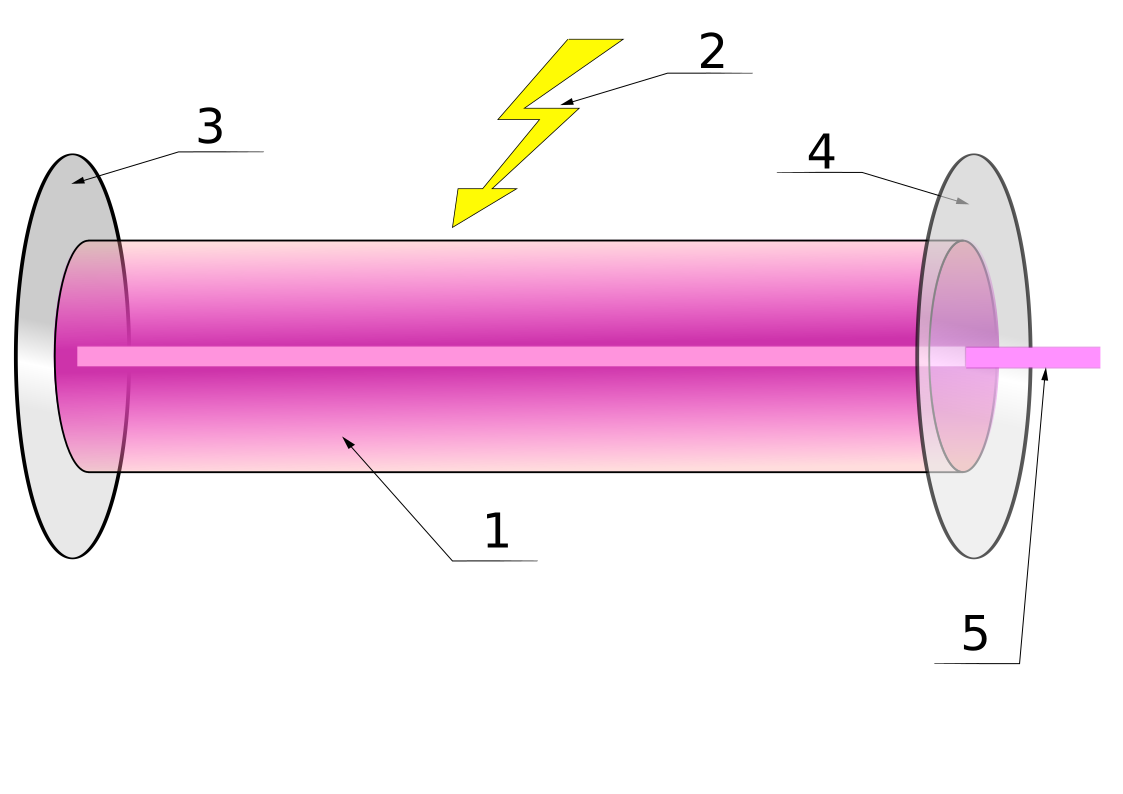 |
| 1) gain medium 2) pumping energy (electricity here) 3) Back mirror 4) Front mirror (and lens, it looks like) 5) Laser beam (via WikiCommons) |
Inside the crystal, the atoms are undergoing population inversion. This nifty little video gives a good visualization of the process. Every atom has discrete energy levels, and in jumping between a higher level and a lower level, can release a photon. In a laser, the idea is to put enough energy into the system that most of the atoms are in the higher energy state, and then releasing that energy in the form of light. Not every material is capable of lasing, because it must be capable of staying in that higher energy state for some (atomically long) time period. Otherwise, it is impossible to achieve population inversion.
That being said, you could make a laser, given the right resources, out of a surprising number of things, including but certainly not limited to, a glass of beer or a gin and tonic. The first thing to do would be to cap the container somehow. In either case, you could with a partially silvered mirror, a fully reflective mirror and an electrical supply use the carbon dioxide dissolved in the liquid to create a laser (albeit not a very good one). In the case of the gin and tonic, tonic water contains a small amount of quinine (the drink is said to have been invented as a way to get British troops to take their malaria medicine, since quinine itself is very bitter), which will fluoresce under ultraviolet illumination. Fluorescence alone will not cause lasing unless you filter the reflected light for a specific wavelength and force all the atoms to the same energy level. This can be achieved using traditional filters, Bragg gratings or nano-fabricated mirrors, which can be tuned to reflect only narrow band light.
That is an extremely brief look at lasers and how they work. But I need to move onto other topics, so this will have to do for now!
~PhysicsGal
Sunday, September 15, 2013
Interferometers
Finally, a physics post! is what exactly none of you are thinking.
The wave splitting interferometer is possibly the simplest to explain, and if you've ever heard of or seen a Young's Double Slit Experiment, you know of the oldest, and easiest to replicate, of the wave splitting interferometers. Its success or failure depends on the spatial coherence of light. In other words, how similar is this part of the beam to any other part of the beam? The way physicists usually quantify this property is in the coherence area. If a source is oddly shaped, and relatively close, it will be spatially incoherent, particularly if it is giving off 'broad band' or white light. You have a large group of random oscillators each creating its own wave, and the waves have nothing to do with each other. You will have a miniscule coherence area. However, oddly enough, if you can get far enough away from the source, the coherence area will increase! Why? Let's go to the ducks!
The main use of this type of interferometer is to determine the coherence of a source. You could use it to determine the wavelength of a coherent source, but there are much easier ways to do that that don't require coherence.

When studying with a friend, it was brought to my attention that I cannot for the life of me remember the different types of interferometers and what you do with them. I can name them, I just can't remember what differentiates them. This is kind of a critical topic for my qualifying exam, so I thought I would write a post on it to try and help me to remember it.
Interferometers are 'old tech' in the world of optics. The main types of optical interferometer were invented back in the 19th century, or very early 20th century. At this point in time, the number of subtypes of interferometers is vast. But except for a few exotic types, the principles of their operation fall into two camps: wave front splitting or amplitude splitting. The wave splitting interferometer splits a beam arbitrarily, either by use of two pinholes/slits, very thin prisms, or cleverly aligned mirrors, which essentially takes chunks of same beam. Amplitude splitting interferometers make use of a beam splitter, which divides the light into reflected and transmitted light, which divides the amplitude evenly. Each has its uses, because they operate on different optical principles.
Wave-Splitting Interferometers
The wave splitting interferometer is possibly the simplest to explain, and if you've ever heard of or seen a Young's Double Slit Experiment, you know of the oldest, and easiest to replicate, of the wave splitting interferometers. Its success or failure depends on the spatial coherence of light. In other words, how similar is this part of the beam to any other part of the beam? The way physicists usually quantify this property is in the coherence area. If a source is oddly shaped, and relatively close, it will be spatially incoherent, particularly if it is giving off 'broad band' or white light. You have a large group of random oscillators each creating its own wave, and the waves have nothing to do with each other. You will have a miniscule coherence area. However, oddly enough, if you can get far enough away from the source, the coherence area will increase! Why? Let's go to the ducks!
If you look at the water, and not the adorable ducks, you'll notice that near the ducks, the water waves are chaotic. Each duck is acting as an independent oscillator, going his own rate in his own location. But as the waves get farther and farther from the ducks, they look more and more like perfect spherical waves you would get from tossing in a pebble (a point oscillator). The incoherent bits cancel each other out at a great distance, and only the coherent bits survive, creating a spatially coherent wave. The same thing happens with light. The other way to think about it is the farther you get from something, the more it looks like a point sources. Starlight is highly coherent (that's why they seem to twinkle), but they are just as incoherent as our sun at the source. The only difference is distance. They are so far away, all that reaches us is the coherent waves. You can observe the same effect with a car headlight, if you live somewhere with low light pollution and enough space to walk a couple hundred yards or so away from the car.
So lets say you've got yourself a spatially coherent source. These days, say a laser pointer will do if you can get your hands on sufficient small double slits. Otherwise, you can do as Young did, which was cut a small hole in the shutter he used to make his room totally dark, cover it with thick paper he had poked a pin hole in, and use the tiny amount of sunlight that filtered in as his source.
By passing the light through two pinholes or slit, you are creating two identical beams of light, each producing uniform waves of light. If you then place a screen far enough away, you can view the interference pattern of the light, the spacing of which will depend on the separation of your slits and the wavelength of the light. How visible the pattern is is determined by the spatial coherence of the light.
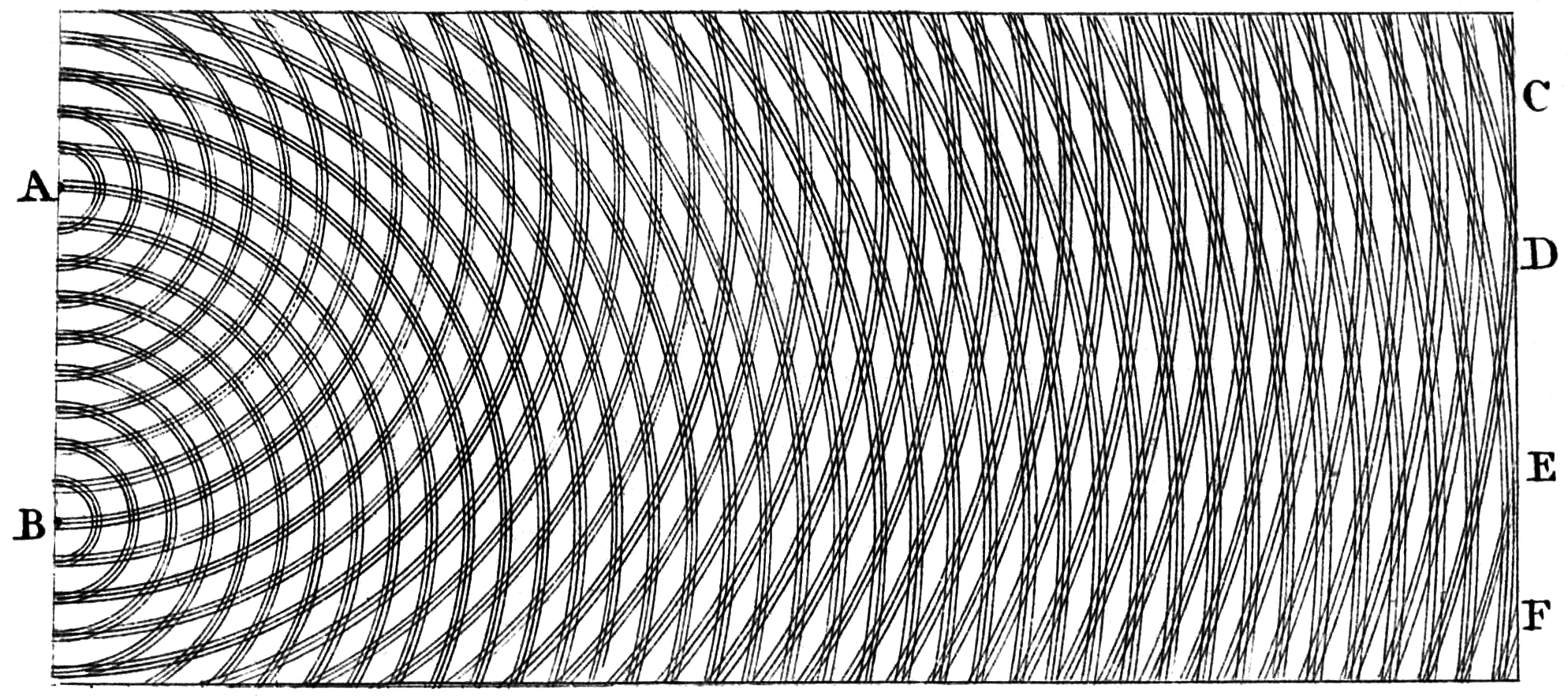 |
| Dr. Young's original drawing of his experiment |
Amplitude Splitting Interferometers
The most basic kind of amplitude splitting interferometer is the Michelson Interferometer. Its many offspring are now more widely used than the original because they are more stable, easier to set up and generally less finicky, but the original is easier to explain I think.
This interferometer depends on a different type of coherence, namely temporal coherence, or how well the beam maintains similarity over time. This makes this type of interferometer very very sensitive to the coherence length of the beam (if a beam is not temporally coherent, a point in the beam that was produced a couple nanoseconds ago, and now a meter away, might not look at all like the beam that is just now being produced.)

The basic set up for this can be seen above. Your light source is aimed at a beam splitter or a half-silvered mirror which divides your beam into transmitted and reflected portions equally. The split beams travel some distance, then reflect off perfectly aligned mirrors, travel back through the beam splitter and interfere on a screen or a detector. If the difference in the distance the beams traveled is smaller than the coherence length, an interference pattern will form. If the coherence length is short, or not of interest, a compensating plate can be used to eliminate the difference in travel time.
So, what can you do with this thing? You can use it to experimentally find the coherence length of a source by moving one mirror relative to the other until the interference pattern disappears. You can use it to do metrology (measurements) and test the quality of your optical instruments. You can use a variation of this in wind tunnels to study air flow patterns, or studying fluid mechanics. A really big version of this can be used in astronomy. Its probably easier to list the scientific fields that don't use some sort of amplitude splitting interferometer than the ones that do. A fiber optics based version of this, the Sagnac interferometer, is used in gyroscopes, but really deserves its own post.
Interferometers were historically important for a whole host of reasons, including disproving aether, proving the wave nature of light and wave-particle duality of electrons. Today they have a million different uses in research and industry and continue to yield new insights into the universe. Its a shame they don't teach them in every basic science class.
~PhysicsGal
Thursday, August 1, 2013
Geometrical Optics: Paraxial Approximation, Ray Trace Method
This is the first of about 25 posts I'll be doing over the next couple of months to help me study for the dreaded qualifying exam. It's said that the best way to learn something is to have to explain it to someone else, so I'm hoping to improve my own understanding of these topics by trying to explain them to a broader audience.
The first topic I'm tackling is ray optics, for a couple of reasons. Its the first optical topic that I learned, and it is in a way the first optical physics created historically. Its also the optical topic that I like least. Hate would be an appropriate word, actually, for my feelings towards ray optics.
Why do I hate it so much? Possibly because the book I used to first learn it was poorly written and so poorly laid out that diagrams and text overlapped. Mostly because I find it unbelievably tedious, simplistic, and it is of little to no use to me, since I am the one optics person who isn't into photography.
What I specifically dislike about Ray Optics:
1)It assumes all light travels as a ray (hence the name). No wave properties, no photons, no interacting EM fields, just lines of light. So, kinda ignores my whole subspecialty (no wave properties, no vortices, no research for me).
2) There are two ways to go about it. The 'correct'-er way, which is essentially geometry and repeated use of Snell's Law, over and over and over. This is usually done with a computer these days. The other is to use the paraxial approximation, which on top of assuming that light is just rays also assumes that we are only interested in the light that goes through a very small area at the center of the lens (para- near, beside axial - axis). This method is only good for a narrow bundle of rays near the center and, while it is easier to do by hand than non-paraxial, it still requires pages of tedious and easily messed up algebra
Why Ray Optics is still taught:
1) It can help a person, such as a lens or systems designer, know what is happening with the light passing through the system. Many errors and aberrations can be determined through ray diagrams and optimization takes place using it.
2) It's an intuitive place to start for a lot of people. Every little kid given a yellow crayon and a piece of paper will draw a sun that looks like this:

The simplest method of doing this is ray tracing. It lets you follow individual rays through the system, and see what it is doing at every point. Its also long winded, because it involves tracing each ray at each interface in the system. Not too bad if you only have one lens, not so fun if you have lots of lenses or lenses and stops. It relies on two basic equations:
For example, two thin lenses in air:

Each dotted blue line represents a 'plane', and the red arrows represent a marginal ray. Number the planes from left to right, starting with the 'zeroth' plane. We will have a total of seven equations, (transfer, refract, refract, transfer, refract, refract, transfer) so we could solve for up to seven unknowns.
Note that each equation relies on information from the one before it to proceed. Depending on the kind of ray you are tracing, you can immediately make some assumptions. For example, since we are tracing a marginal ray, we can assume that its start and end height are zero. I've set up the example so that the first lens acts as the ASTOP, so we assume its height at the first lens is the edge of the lens. You can assume all n's that represent air are 1. This plus a little additional information will allow a complete solution.
A faster method is the transfer matrix method, which I will get into in the next post, because this one has already taken long enough to write. Hopefully I can make future posts a little less dry as dust.
~PhysicsGal
The first topic I'm tackling is ray optics, for a couple of reasons. Its the first optical topic that I learned, and it is in a way the first optical physics created historically. Its also the optical topic that I like least. Hate would be an appropriate word, actually, for my feelings towards ray optics.
Why do I hate it so much? Possibly because the book I used to first learn it was poorly written and so poorly laid out that diagrams and text overlapped. Mostly because I find it unbelievably tedious, simplistic, and it is of little to no use to me, since I am the one optics person who isn't into photography.
What I specifically dislike about Ray Optics:
1)It assumes all light travels as a ray (hence the name). No wave properties, no photons, no interacting EM fields, just lines of light. So, kinda ignores my whole subspecialty (no wave properties, no vortices, no research for me).
2) There are two ways to go about it. The 'correct'-er way, which is essentially geometry and repeated use of Snell's Law, over and over and over. This is usually done with a computer these days. The other is to use the paraxial approximation, which on top of assuming that light is just rays also assumes that we are only interested in the light that goes through a very small area at the center of the lens (para- near, beside axial - axis). This method is only good for a narrow bundle of rays near the center and, while it is easier to do by hand than non-paraxial, it still requires pages of tedious and easily messed up algebra
Why Ray Optics is still taught:
1) It can help a person, such as a lens or systems designer, know what is happening with the light passing through the system. Many errors and aberrations can be determined through ray diagrams and optimization takes place using it.
2) It's an intuitive place to start for a lot of people. Every little kid given a yellow crayon and a piece of paper will draw a sun that looks like this:
Light travels in straight lines. Sundials, shadow puppets and dressing room mirrors that let you see your back all seemingly demonstrate this to us every day.
3) Realistically, its probably the most practical optical analysis for the real world. Wave optics may be more correct, more precise, show things in greater detail, but it is also computationally intensive. In a commercial setting, the approximation that takes 5 minutes to run and give you an answer you can use immediately is going to trump the precise calculation that takes a week to run and another week to analyze.
I'm going to focus on the paraxial approximation, and the simplest method of doing for this post, because otherwise it was threatening to become a book.
The paraxial approximation is takes all the assumptions made to get ray optics in the first place and adds the assumption that you are only interested in using the lens right around its center, so all your angles are very tiny, and that the lenses are 'thin' so the curvature is small and you can neglect the distance the light vertically travels in the lens itself. Is it realistic? No, of course light is going to go through the whole lens, not just at the center. But this analysis can be done by hand in about 15 minutes if you aren't prone to sign errors, and can give a person a good idea of what the limiting factors of their system is and what the main aberrations are likely to be. Its kind of like a systematized back of the napkin calculation you do before you do a proper analysis with ray trace software, which is finicky and you want to know what your answer is going to look like before you use it.
The crux of this method is that we assume $sin \theta = \theta$. That is, that the angles are so small that the sine of the angle is (roughly) equal to the angle itself. When doing sketches of this method the angles often look huge (30 degrees or more) but the sketches have the implicit caveat 'not to scale'. It would be unenlightening (and frustrating) to be drawing angles of a few degrees. For one thing, the lines would end up overlapping.
The simplest method of doing this is ray tracing. It lets you follow individual rays through the system, and see what it is doing at every point. Its also long winded, because it involves tracing each ray at each interface in the system. Not too bad if you only have one lens, not so fun if you have lots of lenses or lenses and stops. It relies on two basic equations:
1) refracting formula: $n'_{i} u'_{i} - n_i u_i = - h_i K_i $
2) transfer formula: $h_{i+1} = h_i + d'_{i} u'_{i}$
$n$ is the refractive index (the subscripts denote which side of the interface it refers to), $h$ is the height above the optical axis of the ray, $u$ is the small angle (no sines or cosines needed), while $K$ refers to the 'focusing power' which for a surface (such as a mirror) is $(n_{i+1} - n_i)c_i$ where $c$ is the curvature or $\frac{1}{f}$ for a lens, where f is the focal length. $d$ refers to the distance between the $ith$ and $(i+1)th$ planes. Once you get the hang of the labeling, its a tedious but simple solution.
For example, two thin lenses in air:
Each dotted blue line represents a 'plane', and the red arrows represent a marginal ray. Number the planes from left to right, starting with the 'zeroth' plane. We will have a total of seven equations, (transfer, refract, refract, transfer, refract, refract, transfer) so we could solve for up to seven unknowns.
1) $ h_1 = h_0 +d'_0 u'_0$
2) $ n'_1 u'_1 - n_1 u_1 = -h_1 K_1$
3) $ n'_2 u'_2 - n_2 u_2 = -h_2 K_2$ {note: $n'_1 = n_2$, $u'_1 = u_2$, assume h1 = h2}
4) $ h_3 = h_2 +d'_2 u'_2$
5) $ n'_3 u'_3 - n_3 u_3 = -h_3 K_3$
6) $ n'_4 u'_4 - n_4 u_4 = -h_4 K_4$
7) $ h_5 = h_4 +d'_4 u'_4$
Note that each equation relies on information from the one before it to proceed. Depending on the kind of ray you are tracing, you can immediately make some assumptions. For example, since we are tracing a marginal ray, we can assume that its start and end height are zero. I've set up the example so that the first lens acts as the ASTOP, so we assume its height at the first lens is the edge of the lens. You can assume all n's that represent air are 1. This plus a little additional information will allow a complete solution.
A faster method is the transfer matrix method, which I will get into in the next post, because this one has already taken long enough to write. Hopefully I can make future posts a little less dry as dust.
~PhysicsGal
Thursday, July 11, 2013
What is/are Singular Optics?
This maybe should have been the first post, but I thought if this were the first post it would set a rather more serious tone than I would like for this blog.
I mentioned in my first post that I'm doing theoretical physics, specifically singular optics, but I didn't really say what that was. Partly because it didn't seem needed, and partially because I don't like trying to explain what I research since I don't fully understand what my field encompasses. Somewhat tautologically, the field of singular optics studies optical fields that display singularities. Since pretty much everytime I say I am studying optics people ask, "So, eyeglasses...?" I think its safe to say each of those terms could use some defining.
The general study of optics covers a section of the electromagnetic spectrum that is centered around the visible range. These days it also covers light a little above and below the visible portion, namely ultraviolet (UV) and infrared (IR) radiation. In a sense, optics is very, very old. There is evidence to suggest that the Ancient Egyptians and Mesopotamians used lenses. The oldest known 'lens' is the Nimrud lens from ancient Assyria, which may have been used as a magnifying glass or to light fires. The contemporary study of optics in some part can be traced to Newton who did a great deal of work with prisms, but optics really could not take off beyond what is now known as geometrical optics until James Clark Maxwell codified existing theories of electromagnetism into Maxwell's equations. This so called 'classical electromagnetism' describes the behavior of light even into the realm of relativity (it is in fact inherently relativistic), but not on the quantum level (you need quantum optics for that). While Maxwell's equations cover the whole of the electromagnetic spectrum, from gamma rays to x-rays to microwaves to radiowaves, 'optics' is considered to only cover a tiny section of that spectrum--the light we can see and the 'colors' just beyond what we can see.
The concept of singularities is essentially mathematical, though it has an obvious physical representation. If something is 'singular', that usually means that it is either a) going to plus/minus infinity b) some part of it has gone to zero, making another part undefined. From the omniscient Wikipedia, "In mathematics, a singularity is in general a point at which a given mathematical object is not defined, or a point of an exceptional set where it fails to be well-behaved in some particular way, such as differentiability." Singularity is the point where the mathematical equivalent of "Monty Python's" The Colonel declares that everything is getting too silly and to get on with it. There is always something weird, and to certain deranged minds like mine, cool about ill behaved math/physics. The obvious and most well known example of a singularity is a black hole. Everything breaks down inside a black hole--no one really knows what goes on inside those things other than seemingly infinite gravity and time dilation.
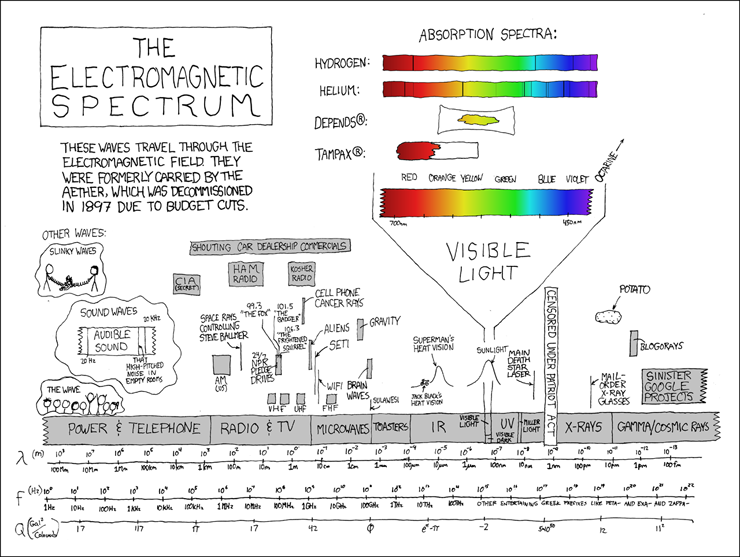 |
| From xkcd.com |
Singular optics is not quite as dramatic as a black hole. I doubt anyone will be making computer skins depicting singular optical phenomena who isn't directly involved in it in some way. Dr Skull over at "Skulls in the Stars" explains it far better than I can, with really cool pictures. Basically, it boils down to this. Light is made up of waves (try to forget about photons for a moment). Waves have an amplitude and a phase. Think of an ocean wave. Amplitude would describe how high above the surface the wave gets, while phase would describe a point along the wave. We tend to think of this as nice, well behaved math and physics. Sines and cosines are easy. The weirdness comes in if you have two waves that are interfering with each other. Sometimes they cancel each other out and sometimes they double up. When they double up, they are still well behaved, which is to say that they have a well defined amplitude and phase. When they cancel each other out though, you have no amplitude, and the phase is undefined. This is the singularity with which this branch of optics deals. Where the phase is undefined, it takes on all possible phase values at once. Which seems like utter nonsense, but it turns out to be very, very useful.
How on earth is this useful? Well, one of the nice things about these singularities is that they create what are known as optical vortices. The light goes around in circles in some sense. Two things are nice about this. One, is that the vortices carry angular momentum, which can be used to rotate things, say microscopic objects held by optical tweezers. Another is that these vortices remain stable under perturbation. They will still go clockwise or counterclockwise, for example, when you send them through a lens or some sort of perturbing medium. In theory, you could use this property to send data optically (i.e., a right-handed vortex = 0, a left handed vortex = 1 for computer bits), perhaps even through free space. There are probably many other applications we just haven't thought of yet because this subfield is only about 40 years old, and lasers are only now becoming relatively cheap.
I am only just starting my research in this field and really only just starting to understand what it all means. I'm sure in a year I am going to reread this blog post and cringe at my pathetic understanding of my own chosen field, but you have to start somewhere. So here it is, my first baby steps of understanding.
Cheers!
Wednesday, July 10, 2013
Hello! (aka, What the heck is this blog?)
Greetings, reader! I'm glad you found this blog, and I hope you find it interesting, helpful, etc.
Historically, I've been really bad about any kind of journal-type righting. I've always been better at writing fictional stories on a regular basis than writing about myself. I'm hoping that this blog will bridge that gap for me.
I am a graduate student doing theoretical physics, specifically doing research into the area known as singular optics. So a lot of my posts will be about physics, and particularly optics. This will especially be true in the next few months as I study for my qualifying exams and use this blog as a tool to study for that great Rubicon of graduate students.
When I'm not working on physics, I'm thinking about or experimenting with what is probably my most useful hobby--food. For health reasons, I frequently need to modify existing recipes or invent new ones from scratch. So some of my posts are going to be about food--my recipes that turned out pretty well (or failed spectacularly, awesome recipes I found, new (to me) ingredients, etc.
Other than those topics, this is my blog and I'm going to feel free to post on whatever seems interesting to me.
I hope to get a proper blog post written at some point, but for now this will have to do. 'Til next time!
Historically, I've been really bad about any kind of journal-type righting. I've always been better at writing fictional stories on a regular basis than writing about myself. I'm hoping that this blog will bridge that gap for me.
I am a graduate student doing theoretical physics, specifically doing research into the area known as singular optics. So a lot of my posts will be about physics, and particularly optics. This will especially be true in the next few months as I study for my qualifying exams and use this blog as a tool to study for that great Rubicon of graduate students.
When I'm not working on physics, I'm thinking about or experimenting with what is probably my most useful hobby--food. For health reasons, I frequently need to modify existing recipes or invent new ones from scratch. So some of my posts are going to be about food--my recipes that turned out pretty well (or failed spectacularly, awesome recipes I found, new (to me) ingredients, etc.
Other than those topics, this is my blog and I'm going to feel free to post on whatever seems interesting to me.
I hope to get a proper blog post written at some point, but for now this will have to do. 'Til next time!
Subscribe to:
Posts (Atom)