Thursday, September 26, 2013

Lasers

Lasers are one of two technologies that led to a revolutionary advance in optics (the other being semiconductors, which I'll discuss in a later post). The word 'laser' was originally meant as an acronym for a curious piece of engineering, that gained such wide traction it has become a word. Technically, it stands for "light amplification by stimulated emission of radiation". Radiation here is the generic term for electromagnetic waves, which encompasses visible light, UV, infrared, microwaves, gamma rays, x-rays and radio waves, among many other types. Since their invention, laser's have become staples of the modern world. They are what make cds, dvds and blurays possible. They are central to anything fiber optic, and have become so cheap and ubiquitous we use them instead of the tradition wooden pointer for presentations, and use them as levels. Their uses in science and engineering are bordering on innumerable, not to mention their use in medicine for precision surgery and low collateral damage treatments. They range from size and potency from smaller than a AAA battery and some temporary blindness if you look straight into it (e.g. laser mice) to the size of a small house and the ability to fuse atoms (lasers at the National Ignition Facility).
Via WikiCommons

Lasers come in several different basic types:dye, gas, solid state, LED/semiconductor, chemical, fiber,  free electron, and more recently 'exotic material' lasers. They each have their advantages and disadvantages.

  •  Dye lasers can give very tunable wavelengths, which is an issue with most lasers, but the materials used are also (more often than not) highly toxic and annoying to work with. They are dropping out of favor as other types of laser become more tunable without the toxicity issues. 
  • Gas lasers are bulky, but low cost, very narrow bandwidth  and very very common. Helium Neon (HeNe) lasers are used for a variety of research and education purposes. Carbon Dioxide (CO2) lasers are used for welding, cutting and telecom purposes (the latter at obviously much lower powers). Depending on the gas used they have a range of available wavelengths. Also, far less toxic than dye lasers. 
  • Solid state lasers use crystals or doped glass as the gain medium. The first laser used ruby. These are typically bulky, and are limited by thermal considerations, but they can output very high powered pulses. They typically have very narrow bandwidths, and are not tunable except by integer multiples of the frequency. 
  • Fiber lasers are a subtype of solid state lasers where the gain medium is many loops of  a fiber. They have  a distinct advantage over bulk crystal lasers in that, since the fiber is very thin, they can be efficiently cooled. However, they cannot operate as at high powers, since the intensity of the light passing through the fiber can cause distorting and non-linear effects. 
  • Semiconductor or LED lasers are lasers that use light emitting diodes to create laser light. Below a certain threshold, the LED acts as a normal LED. Above a certain amount of current, the material begins to lase. This type of laser can be very compact (they are used in laser pointers for example), and offers a broad range of available wavelengths, presently from near UV to  near IR. They are relatively inexpensive compared to other types of laser media. 
  • Free electron lasers are kind of an oddball laser, because it uses a relativistic beam of electrons as its lasing medium. They are huge (garage sized), incredible expensive, but also high powered and highly tunable. They are not as popular now that LEDs can offer much the same tunability. 
  • Chemical lasers are used for applications were very high powers are needed, such as military applications. Instead of pumping a lasing medium with light or electricity, a violent chemical reaction is used. 
  • Exotic material lasers use different types of radioactivity to pump a medium. These are more lab experiments at the moment (Although I'm sure someone would think of a use, I can't think of why I would want to use radioactivity and not light or electricity).
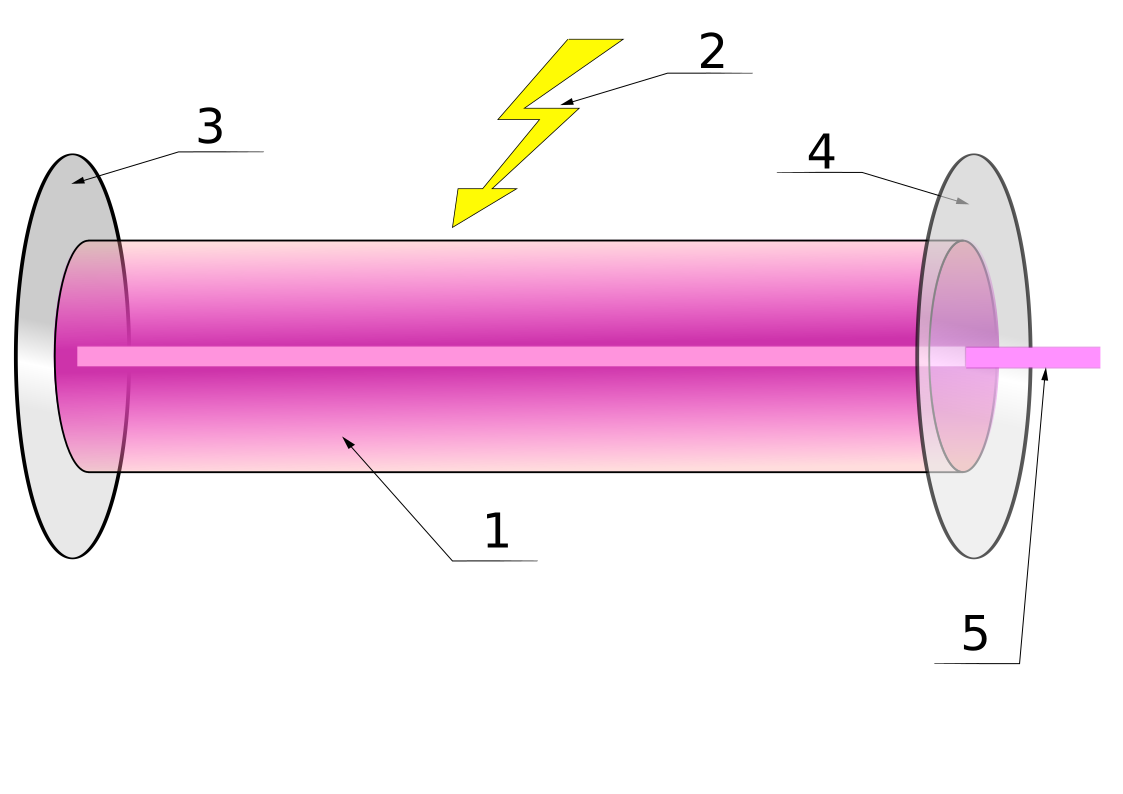
 With the exceptions of the free electron laser and chemical laser, lasers work in a weird but fairly simple manner. The gain medium is confined and two partially silvered, concave mirrors are put at either end (in the case of electrically stimulated lasing, only one mirror need be silvered). Because the mirrors are partially reflective, partially transmissive, pumping light can come in, and laser light can leave, but roughly half the light can be contained to continue the population inversion necessary for lasing. Curving the mirrors inward, even slightly, helps to avoid light lost at the edges and diffraction effects. Outside of the cavity, there will be a series of lens to produce a clean light beam, and make sure it is going in the right direction. In the case of a solid state laser, there is usually an optical diode to prevent light from coming back in and destroying the crystal. 
1) gain medium
2) pumping energy (electricity here)
3) Back mirror
4) Front mirror (and lens, it looks like)
5) Laser beam
(via WikiCommons)
Inside the crystal, the atoms are undergoing population inversion. This nifty little video gives a good visualization of the process. Every atom has discrete energy levels, and in jumping between a higher level and a lower level, can release a photon. In a laser, the idea is to put enough energy into the system that most of the atoms are in the higher energy state, and then releasing that energy in the form of light. Not every material is capable of lasing, because it must be capable of staying in that higher energy state for  some (atomically long) time period. Otherwise, it is impossible to achieve population inversion. 

That being said, you could make a laser, given the right resources, out of a surprising number of things, including but certainly not limited to, a glass of beer or a gin and tonic. The first thing to do would be to cap the container somehow. In either case, you could with a partially silvered mirror, a fully reflective mirror and an electrical supply use the carbon dioxide dissolved in the liquid to create a laser (albeit not a very good one). In the case of the gin and tonic, tonic water contains a small amount of quinine (the  drink is said to have been invented as a way to get British troops to take their malaria medicine, since quinine itself is very bitter), which will fluoresce under ultraviolet illumination. Fluorescence alone will not cause lasing unless you filter the reflected light for a specific wavelength and force all the atoms to the same energy level. This can be achieved using traditional filters, Bragg gratings or nano-fabricated mirrors, which can be tuned to reflect only narrow band light. 

That is an extremely brief look at lasers and how they work. But I need to move onto other topics, so this will have to do for now!

~PhysicsGal

Tuesday, September 24, 2013

The best anti-anxiety: a loving dog

I'm not a laid back person, if you couldn't tell yet. I have a lot on my plate right now. I'm stressed.

A lot of my old stress relief (chocolate, bread, chocolate in bread, among other things) are now no longer options. My favorite bar (with wine and warm chocolate) and best friend  are in completely different states.

What I have is a small, energetic dog (Penny) who wants nothing more, it seems, than to cuddle with me, lick my face and take walks around our quiet neighborhood (also, car rides, but those are less frequent). And she is weirdly in tune with my moods, and is marvelously forgiving when I am in a truly horrible mood.

This morning, I was in a horrible mood. I was in a murderous, panicky, run-away, I-will-strangle-the-next-person-who-talks-to-me mood. I took Penny for a walk, like I always do before I head to work.

She is the most exuberant little thing. She walks along beside you and then jumps after a cricket, and then comes back. She smells the wind, and then just grins at you. Two miles of this, I was, if not zen, calm enough to smile when my students walked into the classroom.

God bless little dogs.

Monday, September 23, 2013

A Plea: PCOS Awareness

I've mentioned before on this blog that I can't have very many carbs, without explicitly stating why. Now I will, because something has been bugging me about it.

I have Polycystic Ovarian Syndrome (PCOS), which despite its name is a multi-system endocrine disorder, with the main problems exhibited in the metabolic and reproductive systems. At conservative estimates, it affects about 10% women of reproductive age, and doctors believe that this number is actually an underestimate because so many women go undiagnosed. Australian researchers put successful diagnosis rates at about 30%. It is the most common cause of infertility, obesity and insulin resistance among women. It leads to increased risk of cardiovascular disease, diabetes, and certain cancers even among sufferers of normal BMI.  It's cause is unknown, and its even unsure which organ is the primary mover (present best guess is adrenal glands), or if it is a fundamental miscommunication between several endocrine centers.

Besides the physical problems that attend this syndrome, women who have PCOS are several times more likely to suffer from depression, eating disorders, and lower quality of life as measured by the PCOSQL survey. It is at this point unknown whether the hormone imbalances which are characteristic of PCOS lead to this, or the fact that the women have received an incurable diagnosis with very few treatment options and almost no social support is to blame.

While I can personally attest to the fact that a PCOS flair can lead to weird mood swings, I'm going to suggest that the higher incidence of depression etc can be blamed almost entirely on external forces.

I am what you could call a best case scenario. I was diagnosed just over a month after symptom onset, thanks to my mother instilling in me early on the need to keep track of things and an incredibly astute doctor. I gained 8 pounds before I knew that I had won the lottery and gotten insulin resistance along with my polycystic, lazy ovaries. Starting with a low glycemic index diet and moving at this point to a very low carb diet let me quickly shed that weight and then some. I'm lighter now than I have been my entire adult life, and I was never overweight to begin with.

But here's the thing. There is no approved treatment for PCOS. Oral contraceptive pills (OCP) reduce the risk of endometrial cancer by not allowing it to build up for months on end, but it comes with its own risks, including increasing insulin resistance in some women. Some doctors will prescribe metformin, a diabetes II drug, to improve insulin response, but its efficacy is in serious question, particularly since more recent studies, what few there are, show that the insulin resistance which accompanies PCOS is fundamentally different than that caused by obesity or other disorders. In fact, researchers are suggesting a name change from PCOS to "Female Metabolic Syndrome" or "Reproductive Metabolic Syndrome" to emphasize the fact that it is a different thing*. If you are overweight, they recommend you lose weight, as in severely obese women this can reverse some of the symptoms.

That's it. Sure, there are some fertility treatments, but those are only if you are actively trying to conceive. If you are just trying to live with it, that is the sum total of what medical science can offer you. Lose weight if you are overweight and exercise, which everyone is told anyway. OCP can reduce cancer risk. Metformin if you are trying to conceive, very overweight or already in diabetes II territory. Reduce carbs and eat lean protein. And...that's it. Go live with this for the rest of your life. This has been the same picture for, as far as I can tell, the past 30+ years.

Millions of dollars are spent every year to make us 'aware' of things like breast cancer (with little to no effect on the death rate, but plenty of effect on the overdiagnosis rate). The NFL, the most manly man sport American's have because we somehow forgot rugby existed and all our hockey players are Canadian, dyes itself bright pink for October and Breast Cancer Awareness month. PCOS has basically nothing. The PCOS association is one of the saddest websites I've seen lately. And its main supporter is a hucksterish faux medical 'lab' that sells 'natural' supplements to desperate people. Research grants go to things like finding out what happens if you give spiders pot, but very little research is done on PCOS. Admittedly, it's complicated, but so is every other medical problem. Not to pick on breast cancer, but PCOS affects more women and the fact that September is National PCOS Awareness month didn't even make it onto Wikipedia. National Fish Month and National Yoga month made it on there though.

So is it any surprise that women with PCOS turn in droves to alternative 'medicine'? That they will eschew what little science there is because it offers them next to nothing and is inadequately explained/offered even when it does (there was an article on the need for more accurate information going out to women with PCOS. File under 'no duh'). We are desperate for relief, for hope, for comfort. PCOS has a way of destroying everything that makes you feel feminine, including giving you a mustache and male pattern baldness, on top of the medical problems. So we will down gallons of herbal teas, pounds of saw palmetto, garlic, ginger, and cinnamon, try acupuncture,  fad diets and fake cures, all in the pursuit of feeling normal again. Even if you are trained in the scientific method and take a strong stance against quacks, it is hard to resist when they promise that you can have bread again, or even just live without watching everything you eat. To not have to spend a small fortune on Gillette/Nair/salons in order to not look like a gorilla. To feel normal again. It can feel like doing anything is better than waiting for your symptoms to just keep getting worse.

So please, anyone who might read this. If you are in a position to give funding, help make this a funding priority. If you are the kind of person who is good at making huge charities, we seriously need help with this one. If you are a bioscience type who leans towards interdisciplinary research, let me encourage you to make PCOS your focus. If you are none of these things, but you know more than 10 women, the odds are good you know a woman with PCOS. She probably feels very alone. If she reaches out to you, let her know she's not alone, and help her resist the quackery and push for more serious research. We will all thank you.

*I would support a name change to either FMS or RMS (leaning towards the latter). For one thing, either sounds more like something you can mention in mixed company, emphasises the fact that its way more than just the ovaries that are affected, and eliminates the polycystic part of the name, which is no longer a necessary part of the diagnosis criteria. Also, it would move us away from saying "Pee-cos", which a) reminds me of Pecos Bill from Tom and Jerry b) just gets on my nerves.

An Arachnophobe Gardens in the Carolinas

I am a life-long arachnophobe. There has never been a time in my memory that I have not been afraid of those little monsters. I have done the recommended 'learn more about them, then you won't be so scared', the 'try to just get used to them' and the 'they are more scared of you'. Nope, because I learned exactly how poisonous some of them are, one tried to land on me, and they do not have the necessary brain structures to be afraid of me. Over the years I have gotten better. I do not immediately flip out over tiny spiders. I can even live with a house spider or two so long as they stay up in their ceiling corner. I don't scream anymore. But I still hate them and am still terrified of them. Keep this in mind.

If you have never been to the USA's southeastern parts, you can have no concept of just how many bugs and spiders we have down here. Colorful, huge ones and tiny little ones you can barely see. Neither size nor color is a good indicator of how much they can or can't hurt you. Fire ants are tiny, but their bite makes an awful, oozing welt that burns and itches. Ghost ants will just eat your food. Really big, iridescent green June bugs will ruin your lawn in their larval stage, but are otherwise harmless. I have learned how to deal with most bugs while I am trying to learn how to garden. I wear long pants to keep off the mosquitos, and I wear a pair of plaid Wellington boots to keep off the fire ants (the plaid probably doesn't dissuade them, but it looks cool). I use bug spray on my arms, my shirt and my hat, again mostly for mosquitos. I wear long dishwashing gloves so I don't have to touch anything with my hand. Yes, I am a little bug paranoid.

This was the manner in which I went to  do some weeding and cut back my gladiolas for the fall. They had grown to be 6 or 7 feet tall and were falling under their own weight, and just looked awful at this point. They are in a fairly swampy part of our yard (in heavy rain, our front yard hosts a little stream that feeds the brook in our neighbor's yard), so I was expecting bugs, slugs, and maybe some frogs.

It started out alright. Most bugs skitter away after all. I could see spider webs and avoid them or knock them down with a long stick. I wasn't being eaten alive. I took down the bronze leaf gladiolas and only came close to a few tiny spiders and has a tiny baby one land on me. I resisted the urge to scream and got it off me, and continued on to the the normal gladiolas. I cut a few down, then realized I needed a different attack angle. Just as I was reaching for a stalk to cut, I nearly touched this.

Please note that this spider's body is almost an inch in length. 

I decided that I wasn't going to be going near those gladiolas until this thing was gone. So I went to clean up the ones I had already cut down. Somewhere around breaking up the 10th gladiola stalk so it would fit into the garden waste bag, a large (body 3/4 of an inch), hairy brown spider crawled out and tried to get on my hand. I threw it down, tried to calm myself down enough to walk away, and decided that was it. I knew I had hit my breaking point. I walked back to the house, stripped off my gloves and boots and started the panicked checking for spiders on my clothes and in my hair. I went upstairs and walked into my husband's office, still not screaming, and asked in a very wavery voice, "I don't have any spiders on me, do I?" He glanced over me and said no and then asked what was wrong. I very very rapidly explained the two huge spiders and promptly burst into tears. 

So much for getting over my arachnophobia.

Thursday, September 19, 2013

Good classes are exhausting

The classes I teach each have their own personality. It's been true every semester. Some of them are sullen, clearly not wanting to be learning physics and resentful that they are being forced to do so. Some of them are studious, just-the-facts-please-ma'am types. Some of them aren't particularly interested in learning physics, but are very pleasant classes nonetheless; they will engage with me, and ask questions that, though meant jokingly, further the class. Once in a while I'll get a class that both wants to learn and will engage, which is the best kind of class. Usually, my good/bad classes are fairly evenly distributed. A goodish class and a badish class each of the two days I teach.

This semester, I have the interesting experience of having two diametrically opposed class types on the two days I teach, Tuesday and Thursday. My first class of the week is dead silent. They stare at me with dull, blank eyes. Pretty much the entire point of my particular class is to give the students a chance to ask questions and engage with the material in a way that is not possible in the larger lecture sections. I have never had a class that did not warm up after the first couple of weeks. The strange thing is that the afternoon section is almost as bad, though at least they talk enough to ask what is on the board when my handwriting slips up.

My third and fourth classes on a different day are completely different. The students will begin asking questions before class begins. They seek me in my office hours. They ask prying questions and joking questions in class. I occasionally have to ask them to be quiet so I can hear what one of them is saying, but I don't mind, since mostly they seem to be discussing the problem, double checking my math, and the like. They sometimes give me great openings for side problems. For example, this week we are covering capacitors, which is usually a fairly simple and dull topic, since we don't do anything fun with RC or LC circuits until later. Then one of my students asked, "Well, what about a flux capacitor?" After a moment of delay (since an actual flux capacitor is something else entirely), I said sure, lets find out how much capacitance it would need to have. So, starting with the "1.21 gigawatts" I led my students through a process of reasonable estimates that go into a 'back of the envelope' calculation, which is so useful in physics and engineering, and is one of those things that every talks about but you rarely get shown how to do until you are in a lab. We found a rough estimate for how many farads that thing would have to be, and came to the conclusion that it could have fit into the train of the third movie, but not the Delorean.

That's the kind of thing that I love to do. It's kind of a silly example, but that kind of engagement is what makes teaching so rewarding to me.

And apparently, exhausting. I am never tired after my first two classes. Frustrated, annoyed, wishing I could get them to talk, yes. But tired? No. After my third and fourth class though I am exhausted. Completely energized while I'm doing it, but worn out afterwards. Is it because I feel more engaged? Because I actually have to think on my feet instead of just repeating the same thing for the umpteenth time? Or is there just something inherently tiring about satisfaction?

Theology: Discipline or Distraction?

If you hang around church circles long enough, at least the kind of church that adheres to a systematic theology, you're bound to hear someone say "I find theology gets in the way of my relationship with God".

I have always dismissed this statement out of hand. I have always considered theology vital to a life of faith. Maybe it was my upbringing. Maybe it's because I am a cerebral person. I understand things by trying to think them through logically. Systematic theology seemed natural. Of course you are going to sit down and try to make everything hang together. This desire fell in line naturally with being  of a scientific inclination. The creation runs along logical (if strange and incredibly complex) lines, why should this order not be a reflection of the creator?

Lately, while I still love systematic theology, I can't help but wonder if there comes a point where systematic theology becomes too...systematic...and begins to obscure the transcendence of God by wrapping it so tightly in carefully woven and laid out arguments. After all, systematic theology is man's attempt to understand that which is ultimately beyond our understanding. All of creation is our plane, and I see no reason we cannot plumb its depths to its very foundation. But can we possibly think that we, who see through the glass but dimly, can wrap up any part of God or his thoughts in a nice little package?

Please don't misunderstand me. I think theology is critically important. And I enjoy the study of systematic theology. But I sometimes wonder if it isn't our tower of Babel, trying make God or at least God's plan of salvation try to fall under some logical progression and rubric? In almost every systematic theology I've studied, there is always some kind of hitch. Something that just doesn't seem to fit with God's character, but is necessary to hold the whole thing together.

On the other hand, I've seen what happens when you jettison theology whole sale. It becomes incredibly chaotic incredibly quickly. You can get something good if you are willing to sit down and do serious Bible study, several hours a day for years. But most people just start making stuff up. And then what you end up with is a mishmosh of Biblical themes or ideas with the person's own philosophical and political slant heavily mixed in. I've met people whose personal theology was so far removed from anyone else's I found it incredibly difficult to have a discussion with them. For every 1 hour discussion, we spent 3 just agreeing to the definition of terms. At the very least, if you study basic theology you can discuss with other people because you share a common language so to speak. And discussion with other people, either your contemporaries or sifting through the thoughts of the saints who have gone before, is a way to weed out your own prejudices.

I don't think theology gets in the way of a relationship with God, but it can sometimes get in the way of having a relationship with other Christians, and can get in the way of relationships with people who don't believe. It's so easy, so tempting to use theology not to understand God, but to intellectually batter an 'opponent'. And I've done this. Arguing into submission is a real problem for me, one that I am trying to fight as I get older. And if I can find a 'debate partner' to do this with where we both understand what we are doing, that's fine. I would even say that its important to discuss theological points, in a non aggressive way, with people of different theological stripes. But a lot of the time it seems we are forgetting Paul's admonition to the the church in Corinth to know nothing among them but Christ, and him crucified.

Jettisoning all our theological differences this side of the second coming is a pipe dream. The way they play out is just too varied and too unsettling if you are used to one and you have to deal with another directly. As a protestant, the Marian Catholic doctrines disturb me. I just can't swallow them, any more than as one of the 'frozen chosen' I can feel comfortable in a service where people are being slain in the spirit and shouting. I'm a  creature of extreme habit, so even slighter variations can make me feel ill at ease.

So what am I trying to say with all this? Theology is a useful tool, but it is just that, a tool, just as models in science are tools, and not reality. We need to be careful how we use this tool, making sure that we are using it to further our understanding of God and his plan for his children, and not as a weapon against our fellow pilgrims. The moment we start thinking that we know what God's thinking because our theology tells us so, and not because the Bible tells us so, it's time to take a step back. At that point, you are mistaking the model for the real thing.

Tuesday, September 17, 2013

"Come, Thou Fount of Every blessing": A meditation


It's been a while since I posted on the wisdom of the saints who have gone before. We sang "Come, thou fount of every blessing", by Robert Robinson, as the closing hymn in church last Sunday, and as always it struck a chord with me. Here is the text, which  is near identical to the first three verses of the original.
Come, Thou Fount of every blessing,  
tune my heart to sing thy grace;
streams of mercy, never ceasing,
call for songs of loudest praise.
Teach me some melodious sonnet,
sung by flaming tongues above;
praise his name--I’m fixed upon it--
name of God's redeeming love.


Here I raise my Ebenezer,
hither by thy help I’ve come;
and I hope, by thy good pleasure,
safely to arrive at home.
Jesus sought me when a stranger,
wandering from the fold of God;
He, to rescue me from danger,
bought me with His precious blood.


O to grace how great a debtor
daily I’m constrained to be!
Let thy goodness, like a fetter,
bind my wandering heart to thee:
prone to wander, Lord, I feel it,
prone to leave the God I love;
here’s my heart, O take and seal it;
seal it for thy courts above.
And yes, this was originally 5 verses. Hymnary, which is a great resource, and has as many versions as they can find hymn books (and they can find a lot), lists only one hymnal, from 1791 and presumably the original, which includes all five. The last two verses are a little...weird. And if the Regency and Victorian hymn book editors left it out, you know they have to be a little funky. To sum it up--the original hymn ends by asking God to tell the singer to "Get me up and die".
Ok, this is a geyser, not a fount, but it looks a lot nicer

This hymn sits proudly in the middle of praise songs, before that term was taken over by sappy Jesus-is-my-boyfriend pseudo pop nonsense. The theme, thesis, focus of the song is God and all that he has done for the one who believes in him. It opens with a supplication to God, the 'fount of every blessing', to change the singer's heart, and teach them how to properly praise God. What could be more pleasing to God than 'some melodious sonnet/sung by flaming tongues above"(other than the repentance of one sinner)? The earnestness of the writer/singer is immediately apparent. Its almost as if his entire being were straining towards this one goal of praising God. It sounds odd, but every time I sing this, I feel a deep sense of yearning, almost homesickness.

The second verse has lead to many a 'huh?' I'm sure, unless you had one of the hymnals which kindly gave the Biblical reference and a note of explanation for what an Ebenezer is. It is, of course, a stone monument raised to commemorate God's help and salvation (Dickens didn't name Scrooge that just because it sounded funny). In fact, the second line essentially explains the first. I love this verse, for all it encompasses. I always imagined that this song, with its declaration with our dependence on God and devotion to him, was a kind of modern day ebenezer (if I actually went around erecting stone monuments for all the times God has helped me, my yard would resemble nothing so much as a grave yard).

The author's description of Christ's salvific act, which brings to mind the parable of the Good Samaritan and the Good Shepherd, and emphasizes the personal quality of Christ's sacrifice.  I like the original wording, which replaces 'bought' with 'interposed', if only because it gives me this mental image of me being in the process of being dragged off to Hell, and Christ stepping between me and damnation to cover me in his blood and purity. Gory and graphic? Yes, but we are talking about eternal damnation here. It should be dramatic. I want to have a sense of the cost. I somehow imagine God as having infinite money, should it come to that. And yes, it says 'purchased with his blood', but purchase has already put money on my mind. Somehow interposing gets the point across better, but that's probably a personal preference, not a theology thing.

The last verse does a pretty little inversion of ideas. Grace is freely given, otherwise it is not grace, but here the singer considers himself permanently indebted to it. We usually think of being saved as being freed from the chains of sin and death, but the writer acknowledges that he is 'prone to wander' and asks that God's mercy be used to fetter (aka old school handcuff) himself to God, so he can't wander away anymore. This reminds us of the seeming contradictions of faith. By choosing faith, we have to give up, or at least try to give up, a lot of our selfish impulses, which to the outside world looks more constrained than ever. But in giving up our 'freedom' to do whatever we want, we gain a new, better freedom in Christ. We can live free from doubt, from  guilt and shame (though we often do a terrible job of showing this). We can live knowing, truly knowing, that whatever happens to us in this life, we have an eternity with God to look forward to. We no longer have to be afraid, not of sin, not of other people, not of anything the world can throw at us. Songs like this remind me of this reality in Christ, and urge me to walk more in the new life, and less in the old.