Showing posts with label trigonometry. Show all posts

Friday, December 12, 2014

Basic Physics: Part 0, Section 5: Derivatives--Exponential Function

In the last post we covered all the rules we needed for calculating derivatives, but I mentioned that there were two special case functions that weren't really special cases that we needed to cover. They are usually thought of as special cases because the way we habitually use and write them hides what's actually going on when we take their derivatives. The first case is the exponential function, and the second is the trig functions sine and cosine. 

The exponential function is something you may or may not have run across directly, depending on how far you got in math or how nerdy your friends are. But it affects or models nearly everything in your life, from population growth to radioactive decay, and is integral to oscillatory functions and nearly every branch of mathematically describable knowledge. The 'natural' number \(e\) is a transcendental number (meaning it's not the root of any integer polynomial) and it's irrational--meaning it never repeats a sequence and it doesn't 
end:
 $$ e = 2.718281828459045235360287471352662497757247093699959574966967... $$ More importantly, it seems to be kinda built into the fabric of the universe because like \(\pi\) it shows up everywhere. Also, it is integral to one of the most beautiful equations in ever--Euler's Identity: $$e^{i \pi} + 1 = 0$$ What's so special about this you ask? Well, it includes 5 of the most basic and important concepts in math and relates them all in an absurdly simple, beautiful way*. The natural number (\(e\)), \(\pi\) and the complex number \(i\) are the most important numbers you've never heard of or used. One and zero are so fundamental explaining why they are fundamental usually leads you in circles. It's also a bit off topic. Back to derivatives!

 The exponential function, the most basic form of which is $$ e^{x} $$ though you can put other stuff (sometimes a lot of stuff) in that exponent. It's usually cited as a special case for derivatives because if you write it the way most people do, it seems like it is it's own derivative:
$$f(x) = e^x$$
$$\frac{df}{dx}= e^x$$
which is weird and uncomfortable and shouldn't be, should it?

This seems to completely violate all the rules we set out, except that it actually follows all the rules and you can demonstrate it three ways. Firstly, if you have enough time and a graphing calculator capable of finding tangents to curves, you can manually (and tediously) show that \(e^x\) is a weird curve whose slope is described by itself. I'm going to skip this way.

Another way to go is to use the power series expansion. This way feels like cheating to me, because in the strictest sense of things, it's an approximation unless I expand the series to infinite terms, but it's also the clearest way for a lot of people.

Let's first start by discussing what a series expansion is. Have you ever wondered how mathematicians can calculate things like thousands of digits of Pi or the natural number when they aren't simple fractions? The answer is power series. Series let you expression something very very complicator or long in a compact format of a bunch of additions. The catch is that, unless you take it out to infinite terms, it's only an approximation. The good news is, you don't need to take it out to infinity for most intents and purposes, because you don't need an infinite amount of precision. You just need 5 or 10 or 100 decimal places worth of precision, which you can get with way less than infinite terms.

The power series expansion for \( e^x \) is
$$e^x = \sum_{n=0}^{\inf} \frac{x^n}{n!}$$
Which looks like a lot of gibberish, but is just mathematician shorthand for
$$e^x = 1 + \frac{x}{1} + \frac{x^2}{1*2} + \frac{x^3}{1*2*3}+\frac{x^4}{1*2*3*4}+....$$
and on and on forever. That ellipsis at the end indicates that it just keeps going like that.

Fortunately, this is something that we know how to deal with, using the rules we learned in section 4.
$$e^x = 1 + x + \frac{1}{2} x^2+ \frac{1}{6}x^3+\frac{1}{24}x^4+....$$
$$\frac{d}{dx} e^x = 0 + 1 + \frac{1}{2} x^1 * 2 +\frac{1}{6}x^2 *  3 + \frac{1}{24}x^3 * 4 + ...$$
$$\frac{d}{dx} e^x = 1 + x+\frac{1}{2}x^2 + \frac{1}{6}x^3  + ...$$

Which is right back where we started! This is a neat and useful property of the exponential function.

The third way is to engage a rule that we didn't discuss last time because it doesn't show up very much, but it's very similar to the chain rule--it's called the power rule and having shown I wasn't lying about the things in part 4, I hope you can just trust me on this one. It's a little messy at the beginning, but just hang with me until the end.

 The power rule goes like this. For a function that has the form of [constant] to the power of [function of variable], like \( f(x) = a^{u_x}\) where \(u_x\) just denotes that \(u\) is a function of \(x\) (yes, a function within a function, it's perfectly legal and it doesn't look as weird as it sounds when you say it out loud...er write it out verbally?), the derivative is
$$\frac{df}{dx} = a^{u_x} *\ln{a} * \frac{du}{dx} $$
Which...looks pretty awful, doesn't it? Just hang with me a little longer. Let's look at a test case. Let's let our \(f(x) = 3^{4x^2}\).
$$\frac{df}{dx} = 3^{4x^2} *\ln{3} * (4*2x) $$
$$\frac{df}{dx} =(8 x) (3^{4x^2}) *\ln{3}  $$
$$\frac{df}{dx} = 8x \ln{3} 3^{4x^2}$$

So, what happens when we apply this to \(e^x\)? Let's see:
$$\frac{d}{dx}(e^x) = e^x * \ln{e} *1$$
Now, the natural log (\(\ln\)) and the natural number are inverses of sorts, so \( \ln(e) =  1\). So that just leaves us with
$$\frac{d}{dx}(e^x) = e^x$$
A perfectly law abiding, if funky looking, function. In reality, it mainly looks weird when we take the derivative because we leave out that \( \ln{e} \) step. Think of it like how a native speaker will use contractions.

Let's test this out on a few more examples to get the hang of it. How about \( g(x) = e^{2x}\)?
$$\frac{dg}{dx} = e^{2x} * \frac{d}{dx} (2x)$$
$$\frac{dg}{dx} = e^{2x} * 2$$
$$\frac{dg}{dx} =2 e^{2x} $$

Still a little weird looking, but not bad from an execution standpoint. Let's do one more for practice.
$$h(x) = 3 e^{4x^2} $$
$$\frac{dh}{dx} = 3 e^{4x^2} * \frac{d}{dx}(4x^2) $$
$$\frac{dh}{dx} = 3 e^{4x^2} * 4*2*x$$
$$\frac{dh}{dx} = 24 x e^{4x^2} $$

Hopefully this has helped you to see that even things that are "special cases" are not exceptions to the rules. If anything is still unclear, please let me know in the comments! Next time, we'll deal with one more "special case", that of trig function derivatives.

*And one of the reasons I will never, ever support tau replacing pi. I don't care if it removes a factor of two from some calculations--it ruins the beauty of Euler's identity to have to divide the exponent by 2.

Updated 12/12/14 8 pm: Corrected the first example. Thanks to @Lacci for alerting me to the problem. 

Wednesday, July 23, 2014

Basic Physics: Part 0, Section 3: Vector Multiplication

Welcome back to my Basic Physics series! In previous sections, I covered some basic algebra topics, necessary trig functionscoordinate systems and vectors. The last post was getting rather long, and since vector multiplication is a bit tricky, I broke that topic into its own section, which you have before you! And I going to further preface this section with this: if you read through this, and you aren't sure you understand what is going on, don't give up! It's not easy to understand, and it looks down right weird; I think my reaction upon first introduction was something along the lines of 'what new devilry is this?!". I'm pretty sure I was using vector multiplication for at least 4 years before really understanding what it is. It didn't stop me from getting a B.Sci in physics, and it shouldn't discourage you from continuing reading this series, because it is possible to use these things without really understanding. Think of it like a car--you use a car everyday, you can make it do what you want, but almost everything under the hood is a mystery. Doesn't mean you can't use it to get you where you want to go! They also get easier with physical examples, which we will get to in coming posts. 

There are two types of vector multiplication. Each has its own uses and peculiarities. This section is going to cover what they are, their peculiarities, and how to do them. They pop up repeatedly in physics, so we'll discover their myriad uses along the way. Let's bring back our two arbitrary vectors from the last post 
$$\vec{v} = a \hat{x} + b \hat{y} + c \hat{z}$$
$$\vec{w} = d \hat{x} + e \hat{y} + f \hat{z}$$
and see what weird things we can do with them!

The first type of multiplication is called the "dot product" (remember that "product" is whatever results from a multiplication), and we get the new symbol \(\cdot \) to indicate that we are combining two vectors using this method. It is fairly straight forward: you multiply the x-hat components together, you multiply all the y-hat components together, you multiply all the z-hat components together and then you add up the results. 
$$\vec{v} \cdot \vec{w} = (a \hat{x} + b \hat{y} + c \hat{z})\cdot(d \hat{x} + e \hat{y} + f \hat{z})$$
$$\hspace{15 pt} = (a*d) + (b*e) + (c*f) = ad+be+cf$$
Interestingly, a dot product of two vectors does not yield a new vector with magnitude and direction, but rather a "scalar" which just has magnitude. This little quirk becomes very important when we get to electromagnetism. It should also be noted that the dot product is commutative, which is to say that 
$$ \vec{v} \cdot \vec{w} = \vec{w} \cdot \vec{v} $$
The same cannot be said of the other type of vector multiplication, which we will get to shortly. 

So, what does a dot product tell you? Speaking geometrically, it gives you the product of the length of the projection of one vector onto another vector. That's about as clear as mud, so lets look at some pictures. Here we have two vectors, \(\vec{A}\) (red), and \( \vec{B}\) (green), with an angle \( \theta \)  between them. 


If we draw a line between the end of \(\vec{A}\) and the point on \( \vec{B}\) where that line can intersect normally

we now have a right triangle. And we know from two weeks ago in the trigonometric section what to do with right triangles. We are given the angle, so by using the cosine function we can find the length of the projection of \(\vec{A}\) onto \(\vec{B}\), kind of like finding the length of your shadow. Let's label that projection \(A_B\) since it's the shadow of \(\vec{A}\) on \( \vec{B}\). So
$$ A_B = |\vec{A}| \cos{(\theta)} $$
with the vertical lines around indicating that we are using the total length, the magnitude, of A and not the vector form. The direction information is not helpful when dealing with triangles. So now we have the length of the projection of \(\vec{A}\) onto \(\vec{B}\). Assuming we have the length of \(\vec{B}\)  we can now find the geometric value of the dot product
$$ \vec{A} \cdot \vec{B} = |\vec{A}| \cos{(\theta)} |\vec{B}|$$
or, more prettily and more commonly,
$$ \vec{A} \cdot \vec{B} = |\vec{A}|  |\vec{B}|\cos{(\theta)}$$
This is another way to calculate the dot product, and is handy if you have been given magnitudes and angles, and not the component form for your vectors. 

But what does this mean, I can imagine you asking. Recall the idea of orthogonality from the previous section. The dot product allows you to relate two vectors based on the degree to which they are orthogonal to each other. If two vectors are perfectly orthogonal, the angle between them is \(90^{\circ}\), there is no projection, no 'shadow' of one vector onto the other, the cosine is zero, and the dot product is zero. The vectors are completely unrelated to one another, and they have no multiplicative interaction. If, on the other hand, the angle between them is \( 0^{\circ}\), then the cosine between them is 1 and they are parallel. They are both going in the same direction and can have the largest multiplicative effect on one another. (If you happen to dot a vector with itself, the angle will be zero, the magnitudes will be identical and you will get the square of the magnitudes. This is in fact how the magnitude of a vector is defined--the square root of the vector dotted with itself.) For any angle in between the effect is proportionately diminished. This will be easier to see when we can give some physical examples. 

The second type of vector multiplication is the "cross product", and the \( \times \) symbol which you probably learned to use for regular old multiplication back in elementary school gets reserved for this particular operation from here on in. Regular multiplication is usually indicated either by abutting parentheses, by an asterisk, or in the case of variable/coefficient terms just writing them next to each other without a space, as in the dot product example above. However, it is not generally as straightforward a calculation as the dot product, because the result of a cross product is still a vector. 

In order to calculate the cross product from scratch, as it were, we need to borrow a tool from linear algebra, namely the determinant*. The determinant is a way to arrange vectors so that you can easily calculate the cross product, no matter the size of your vectors. It is basically an organizational tool.  Once again, let's use the general vectors \(\vec{v}\), \(\vec{w}\), and calculate the cross product of \( \vec{v} \times \vec{w}\). 
$$ \vec{v} \times \vec{w} =\begin{vmatrix}\hat{x}& \hat{y} & \hat{z} \\ a & b & c \\ d & e & f  \end{vmatrix}$$
First, let's dissect what this thing is, line by line. 

 The first row is a label row of sorts. They label each column and they will help label the results. All the \(\hat{x}\) components go in the column under the \(\hat{x}\); if there is no \(\hat{x}\) component to a particular vector, that column gets a 0 for an entry for that vector's row. The same goes for the rest of the directions, namely \( \hat{y}\) and \(\hat{z}\).


 The second row is where the elements from the first vector, in this case \(\vec{v}\) are placed in their respective columns. Remember, if a vector is lacking an element, it is entered as a zero; the column is not deleted entirely, even if all it contains is the label and zeros.

The third row is treated in the same manner as the second row, except that it contains the second vector, in this case \(\vec{w}\). It's rather like filling out a spreadsheet. 

Now what do we do with this thing? 

You first calculate the \(\hat{x}\) component. To do this, you imagine blocking out everything that shares the \(\hat{x}\) column and row, leaving you with a square of components that are not the \(\hat{x}\) component

With those remaining 4 elements, you multiply the diagonal elements, and subtract the lower left/upper right pairing from the upper left/lower right pairing. So the results of this step are 
$$\hat{x} (bf-ec) $$
Note that the \(\hat{x}\) component of the product contains every element except the \(\hat{x}\) components of the  original vectors. Cool, right?

The second step is a little strange, because by blocking out everything in the \(\hat{y}\) element's column and row, we get a kind of split square, or two rectangles. 

What this means is that you have to subtract this result from the final product. You multiply the elements from the two rectangles as though it were one square, so this component of the product gives us
$$-\hat{y}(af - cd)$$
So far, so good. 

The last component is almost identical to the first. 

And you find the results the same way you did for the \(\hat{x}\) portion of the product. So the final bit is 
$$\hat{z}(ae-db)$$
Weird, but not too horribly complicated.  So the final result is 
$$\vec{v} \times \vec{w} = \hat{x} (bf-ec) -\hat{y}(af - cd) + \hat{z}(ae-db) $$

Some people are able to simply memorize the result given above, and don't bother to use the determinant. I am not one of those people gifted in memorizing formulae.  It's easier for me to remember a compact method or tool than to memorize lines of elements. 

It should be noted that the cross product is not commutative--the order in which things are multiplied matters, unlike the dot product. That is to say, \( \vec{v} \times \vec{w} \neq \vec{w} times \vec{v}\). It is however anticommutative, which means that reversing the order negates the result: \( \vec{v} \times \vec{w} = - \vec{w} \times \vec{v}\). 

So, what does the cross product give you? This is a little easier put than the dot product. The cross product calculates the area of the parallelogram whose sides are defined by the two vectors. 
So what's all that vector information doing? Well, hold on to your socks, it turns out that area is a vector quantity. Yep, and the direction of that area is normal to the surface which the area is a measure of. So if you can imagine standing on that parallelogram, which every direction is straight out of your head is the direction that that area points! This also make clearer an important point about the cross-product, which is that the resulting vector from a cross product is necessarily orthogonal to its two parent vectors. The two vectors must lie in a plane to form a parallelogram, and the normal to that parallelogram must be normal to the two vectors defining that parallelogram. 

The fact that the cross product calculates the area of a parallelogram leads us to our last point. What if you don't need to know which way the area is pointing, for some reason? You just need the magnitude of the result, not the whole thing. Well, if you remember your geometry you might recall that the area of a parallelogram can be found by multiplying the lengths of the sides and the sine of the angle between the sides. The same formula works for the cross product in a way. Assuming you have the magnitudes of each vector and the angle between them, you can find the magnitude of the cross product, at the cost of the direction information. 
$$|\vec{v} \times \vec{w} | = |\vec{v}| |\vec{w}| \sin{(\theta)}$$

That wraps up what you need to know from vectors. I know it may seem like a lot, but remember that it's a tool in our tool kit for physics. We will be using these tools frequently, and like any skill it becomes easier with use, and you get to build more incredible things the better you become!

As always, I hope that I have explained things clearly. If I haven't, please let me know in the comments, and I'll do my best to clarify!

*DH objected to this section, because what physicists call a determinant is technically a 'formal determinant', as it has the right form but does not adhere to the strict definition used by mathematicians. If you should show this to a mathematician, they will twitch, and possibly rant about physicists. This is the normal reaction of mathematicians to physicist notation. 

However, the math editor of this blog, sirluke777, objects to DH's objection, and says it's perfectly fine. His background is math, physics and chemistry, so make of that what you will. If there is an outcome to this math geek debate, I will update here. 

Tuesday, July 1, 2014

Basic Physics: Part 0, Section 1: Trigonometry

In Part 0, Section 0 I gave an overview of two basic algebraic skills needed to learn physics effectively. In this post I will explain several trigonometric (hereafter abbreviated to 'trig') ideas that are indispensable when physics problems are in more than one dimension. Since the world we live in is three dimensional, trig is really quite useful. \(\require{cancel}\)

Now, there is a lot more to trig than I am going to discuss here, mainly because we only need this one small portion to be able to tackle physics at this level. But trig is a much deeper subject with really interesting insights, if your fancy is tickled by beautiful interconnected math.

So to begin, we are going to need a triangle. This should be clear just from the name, which comes from the Greek for 'triangle' and 'measure'. More specifically, we need a right triangle, which is a triangle that possesses a \(90\) degree angle (a 'right' angle). You may have run into them before if you ever had to do anything with the Pythagorean Theorem. Right triangles are very nice to work with because you automatically know one angle, so all you need is is either two side lengths or a side and one of the other two angles and you can deduce everything else. So let's begin with a basic right triangle:

You will be subject to the same drawings and handwritten labels as my students are/will be
This is just a run of the mill right triangle. Each of the sides is labeled with a term that both labels it and can be used to indicate or find its length. The little square in the bottom righthand corner of the triangle tells you (as it says in the picture) that that angle is \(90^{\circ}\) (degrees). One of the other angles, in this case the one in the lower left hand corner of the image, is specified using the Greek letter \(\theta \) (pronounced 'theta') to stand in for whatever the actual measurement is.

Before we go any further with triangles, I want to say a few words about the use of Greek letters in math and physics. When I was younger, I thought that weird looking symbols were the sign of TRUE MATH and required REAL SMARTS to use. An equation could look like pure gibberish to me but so long as it included some Greek letter it must contain a great truth about the universe. Then I started taking physics and math classes and realized NOPE. They are, basically, there because we ran out of useful letters in the Carolinian alphabet we use in western European languages. We set aside a bunch of Greek letters to stand for quantities that pop up a lot (e.g. \(\phi, \theta \) are generally reserved for angles) and free up \(a\), \(b\), \(c\), to be used as needed. In other words, Greek letters do not imply fancy-shmancy calculations. They say "we needed more letters and  these were easy to co-opt".

So, getting back to our representative right triangle, which I am going to post again  so you don't have to scroll back up to see what I'm talking about.

 For this triangle, we are given all the information we could possibly want or need. Yes, even that unlabeled corner. First of all, all triangles* have angles which must sum to \(180^{\circ}\). The right angle eats up half of that (\(90 ^{\circ}\) ) automatically. The remaining \(90^{\circ}\) are divided between the other two angles. So if we know \(\theta\) we know the other angle is going to be \(90^{\circ}-\theta\). But secondly,  and most importantly, we don't need that third angle. Trigonometry lets us get away with just one angle, using the power of

Repeated like a prayer at every physics 1 exam
You may have seen or heard this mnemonic before. Maybe carved into a desk in a high school math classroom, maybe muttered by some flustered-looking college student. This acronym is a way to remember the names and definitions of the three most important trig functions: sine, cosine, tangent. Each of these functions describes a ratio, or a particular relationship between two sides of a right triangle and one of its angles.  So in this picture,

our chosen angle is \(\theta\), so all of our ratios, all of our functions will be found with respect to this angle. The side of the triangle that connects our angle and the right angled corner is known as the 'adjacent' side. In our triangle, that would be side '\(a\)'. The other side (or leg) of the triangle that is connected to the right angled corner is called the 'opposite' side, which in our case would be side '\(b\)'. The last side that does not connect to the right angle at all is called the 'hypotenuse', and is the longest side of any right triangle. In this case, side '\(c\)' is our hypotenuse.  The reason that the hypotenuse has to be the longest side is because of the Pythagorean Theorem which states that for a right triangle, the square of the first leg plus the square of the side of the second leg will equal the square of the side of the hypotenuse. Mathematically, $$a^2 + b^2 = c^2,$$ and so the hypotenuse ('\(c\)') will always be bigger than either leg. You can prove this to yourself with a bit of graphing paper. Although you do not have to do so, I can tell you it is easiest to demonstrate this with a 3-4-5 triangle (a triangle whose legs measure 3 units and 4 units and whose hypotenuse is therefore 5 units).

Now, let's get down to the nitty-gritty definitions. This is where most people start to have problems, because while you can express the trig functions as simple ratios, what  they *are* is a little tricky. Lets start by expressing them as simple ratios, and work backwards to what it all means.

The function \( \sin{(\theta)} \) (said 'sine of theta') gives us the ratio between the 'opposite' side ('\(b\)') and the hypotenuse ('\(c\)')**. Explicitly, $$\sin{(\theta)} = \frac{b}{c}, $$ and thus the mnemonic for the sine function being "SOH": Sine [is] Opposite [over] Hypotenuse.

The function \( \cos{(\theta)} \) (said 'cosine of theta') gives us the ratio between the 'adjacent' side    ('\(a\)') and the hypotenuse ('\(c\)'). Explicitly, $$\cos{(\theta)} = \frac{a}{c}, $$ and thus the mnemonic for the sine function being "CAH": Cosine [is] Adjacent [over] Hypotenuse.

And lastly, the function \( \tan{(\theta)} \) (said 'tangent of theta') gives us the ratio between the 'adjacent' side ('\(a\)') and the 'opposite' side ('\(b\)'). Explicitly, $$\tan{(\theta)} = \frac{b}{a}, $$ and thus the mnemonic for the sine function being "TOA": Tangent [is] Opposite [over] Adjacent.

I should note that there are functions for the opposite ratios (hypotenuse over adjacent, etc) but they are rarely, if ever, used in physics at this level and I honestly don't see them pop up in physics at any level.

That's all well and good, you might say to me through your computer screen, but what is 'the sine of theta'? What if I just have an angle? How do I find the sine of it then?

Simple answer? Calculator or an online tool like Wolfram Alpha. But let's face it, that's a cop out, not an explanation.

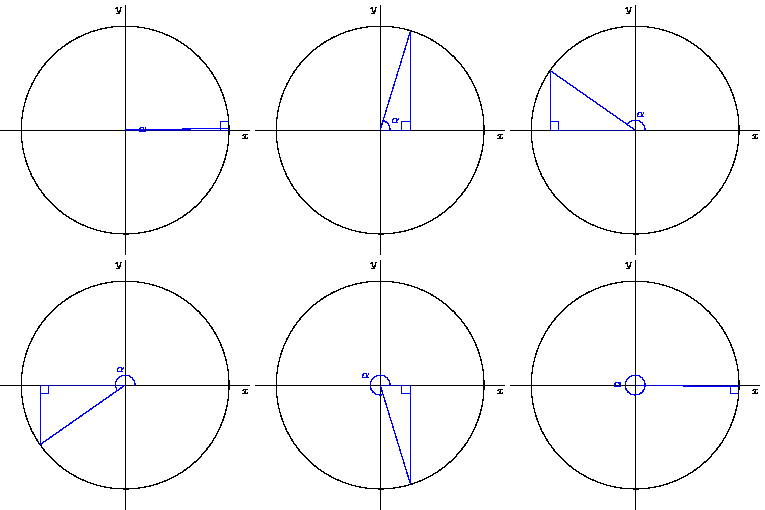
The way to find the sine (or cosine or tangent) of any angle is using a thing called a unit circle, illustrated so very nicely below.

Via WikiCommons, Public Domain
A unit circle is simple a circle of radius \(1\). Right triangles are created using the radius of the circle as the hypotenuse of the triangle and drawing a vertical line connecting the x-axis and where the radius meets the circle. If you move the location of the radius, 'sweeping' though the full \(360^{\circ}\) of the circle, the triangle changes accordingly.

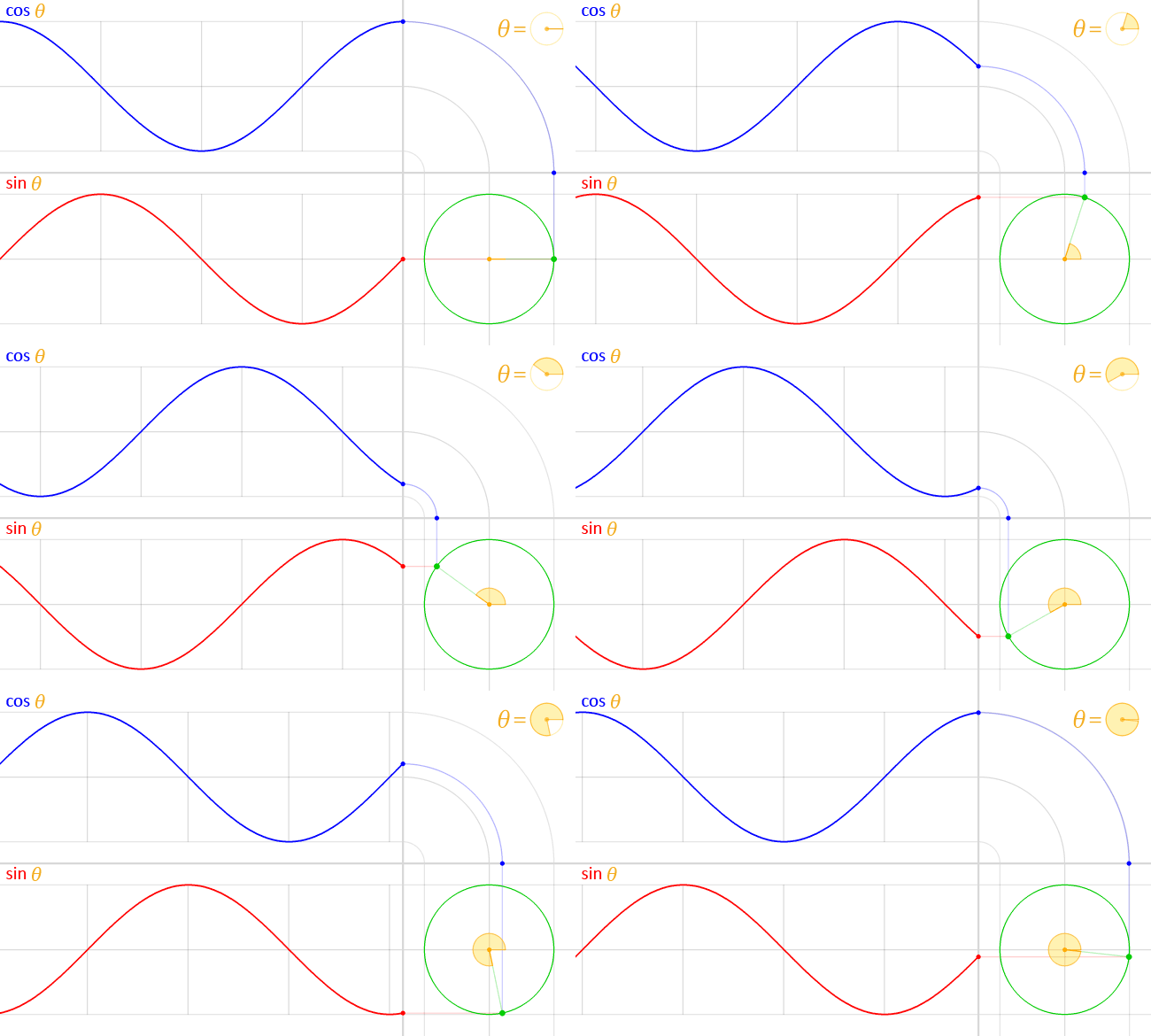
Now I want you to imagine that at every increase of \(1^{\circ}\), we measure '\(b\)', the vertical leg or the 'opposite' side. We then plot, or map out, that leg height against the number of degrees in our angle. We do the same for  '\(a\)', the horizontal leg or 'adjacent' side. Since our hypotenuse has a value of \(1\), by plotting out the height and length of the two legs we are plotting the sine and cosine functions, as shown in this nifty graphic***.
Via WikiCommons, Public Domain
This goes on forever. One of the cool, and occasionally frustrating to scientists, thing about the trig functions is that they go on forever. They never slow down, approach any sort of limit. If you could keep tracing the unit circle forever, you would keep producing sine and cosine waves.

So, how does this help us with our triangles back there? Remember that at their hearts, trig functions are ratios. And ratios scale, as any cook can tell you (though in cooking you do reach some practical limitations on the ability to scale). If I want to make a double batch of spaghetti sauce, I don't have to reinvent my recipe. If my one-batch recipe calls for one garlic clove for a pint of pureed tomatoes, I know that for my double batch I need two garlic cloves for \(2\) pints of pureed tomatoes, and I will still get the same tomato sauce. Similarly, if I know the sine of an angle, say \( \sin{(30^{\circ})} = 0.5 \), I am saying that on the unit circle, the vertical leg is half a unit long. So for any right triangle that has a \(30^{\circ}\) angle, the side opposite that angle will be half the length of the hypotenuse!

Let's work through an example of this. Here we have right triangle, with one angle given and one side length.


It's considered good practice, and it becomes much easier to do this when pictures become more complex, to label the picture with symbols and give the value to those symbols elsewhere. It makes the image cleaner, and leads to fewer errors.

So, what can we find out about this triangle? We have chosen our angle (or it was chosen for us) and we have the 'adjacent' side length. We could start by finding the 'opposite' side length using the tangent, which gives us the relationship between the angle and the two legs. Let's call the 'opposite' side '\(y\)'. Then we can say $$\tan{(\theta)} =  \frac{y}{l}$$ and we can solve for \(y\) using just a touch of algebra $$l\times \tan{(\theta)} =  \frac{y}{\cancel{l}} \times \cancel{l} $$ $$l \times \tan{(\theta)} =  y$$ and then to keep with convention we flip the sides of the equation to the thing we are solving for is on the left hand side (frequently abbreviated LHS): $$y =l \times \tan{(\theta)}.  $$ Now we can plug in our values if we like to find the value of '\(y\)'. Since \( \theta= 30^{\circ} \) , \( l = 5\, \text{cm}  =  .05\, \text{m}  \) and  $$y=\left(0.05\,\mathrm{cm}\right)\tan\left(30^{\circ}\right)= 0.03\, \mathrm{m} =3 \,\mathrm{cm} $$ You may be wondering why I converted from centimeters (cm) to meters(m) and then back again. This is again just a 'best practice' thing. It does not make a big difference in situations, like this, were there is only one unit (length), but when we start calculating things like forces, we will be combining different units into other units and it becomes very important to make sure all your units are base units (e.g. meters, seconds) or you can easily end up with an answer a thousand times bigger or smaller than it should be.

So now we have the 'opposite' side of the triangle. We now have several options on how to find the hypotenuse. We could use the sine or the cosine to find the hypotenuse (call it '\(h\)') in much the same way that we used the tangent to find '\(y\)'. Or we can use the Pythagorean Theorem to find it, which is my preferred method. Plugging in our particular terms to the formula we get $$l^2 + y^2 = h^2.  $$ To extract the '\(h\)' value we need to take the square root of both sides: $$ \sqrt{l^2 + y^2} = \sqrt{h^2}$$This is the same as raising both sides to the power of 1/2, so \( (h^2)^{1/2} \) becomes just \( (h) \). So  we find that $$ h = \sqrt{l^2 + y^2} = \sqrt{(.05\, \mathrm{m})^2 + (.03\, \mathrm{m})^2 }  = .05773627...  $$ $$ h \approx 6\, \text{cm} $$ And now we know everything about this triangle!

So, why do we need this? What arcane bit of knowledge am I trying to put in your head? What good does it do to know anything about this *one* triangle? How will this help me in physics?

Good questions.  First of all, I want to emphasize that, while math is beautiful and worth knowing for it's own sake, for a student of physics I find it useful to think of math concepts less as "yet another thing I have to learn" and more like a tool in your tool kit. Just like you need multiple, different tools to attack house repair (a hammer to drive nails, a screwdriver for screws) you need different tools to break down a problem and then build up your answer. Having these basic trig functions in your back pocket gives is like having a drill and driver set for a power drill. You can use it to both break down and rebuild the problem.

Secondly, by knowing about this one triangle, you are now able to attack any right triangle, no matter its shape or orientation in space.
All equally susceptible to attack by trig
And by knowing about one triangle, you allow yourself to know about triangles which can be drawn as extensions of that main triangle. Why exactly you would want to do that will be made more clear in a few weeks when we get into physics, so you will have to take me for my word on that for now.

Lastly, by being able to translate between angles and the sides of a right triangle we have set ourselves up to deal aptly with another very important concept for physics--vectors!

As always, please leave any questions in the comments section!

*In Euclidean, or flat, space. If you drew a triangle on a sphere, it would not have angles totaling \(180^{\circ}\)

**You may notice that I kept 'opposite' in quotation marks, but not hypotenuse. This is because while the hypotenuse is fixed, which side is called the 'opposite' depends on which angle you chose for your reference.

***Here's another graphic that shows a little better the cosine function, but it's not as smooth and it's labels are in German

Monday, June 30, 2014

Basic Physics: Editorial Consortium

The next promised post on trigonometry is in the final polishing stages, but in the meantime I would like a post to mention several people who have graciously agreed to help me in this endeavor to bring the first year of a physics majors schooling in physics to a non-math, non-science types audience.

 I know full well that as a grad student in physics I am a very bad judge of what is and isn't understood or common knowledge. Teaching has helped rein me in enormously, but my students are assumed to have at least basic calculus knowledge. So I anticipated myself having a problem recognizing what needed more explanation, what was over-explained or even patronizing. I don't want to be the detective novel criminal who spells all the easy words wrong and all the hard words right (in reverse, kinda). Dear Husband, my usual editor, is too well versed in math to much use in this particular arena, so I reached out to some other family members, specifically my mother, my sister, and my brother, to help make sure I do this right. I asked them to do this because each of them brings something that I felt I really needed on what I am dubbing my Editorial Consortium.

My mother is in the demographic group, you might say, that always gives me deer-in-the-headlights or horrified looks when I say I do physics and protest it was too hard for them. Though very talented, she has not directed her talents in a STEM field direction. She is, however, the only reason that I can do long multiplication or division and light years ahead of me in mental arithmetic (also cooking, social skills, language, and checkbook balancing). She is also a natural copyeditor of high standards who is not shy of letting me know when I have fallen short of the mark.

My sister, hereafter to be referred to as Sylvia, Historian Extraordinaire, just graduated college with an absurd amount of honors with a major in History and a minor in French, her thesis work (yes, thesis for undergrad) being on Dorothy L. Sayers. She has a good math background, but hasn't used it much, having no call to do calculus as a literary historian. Her one and only basic physics class was the same one in high school that inspired me to physics. She is also representing a group that I want to reach--younger adults--and she would know if a reference is too obscure. She is also incredible at calling me out for being obtuse and/or patronising.

Last, but not least, is my brother, who will start high school in the fall. I included him for three reasons. First of all, he has had all of the math that I claim is required to understand the blog, but has never taken a physics class in his life. He's interested in the sciences, but he is yet untainted by misconception and bad teaching (other than my own). Second of all, it turns out he inherited Mother's copy editing skills and is very good at noting my inconsistent use of single and double quotation marks. Thirdly, I'm curious if the explanations are clear enough for younger persons who might be interested, but don't have much of a background. The flip side of my mother, so to speak.

They have all agreed to read, edit and comment every post that I write in this series. Between them all I think there is a fair shot that I will do what I set out to do. But I won't know if I am actually succeeding unless you, the reader, let's me know. You are the other part of this Editorial Consortium. If something is not clear, if I mess something up or forget something or just plain gloss over with the hated "the reader can obviously see", let me know! There is a comments link below each post. I'd love your feedback.